

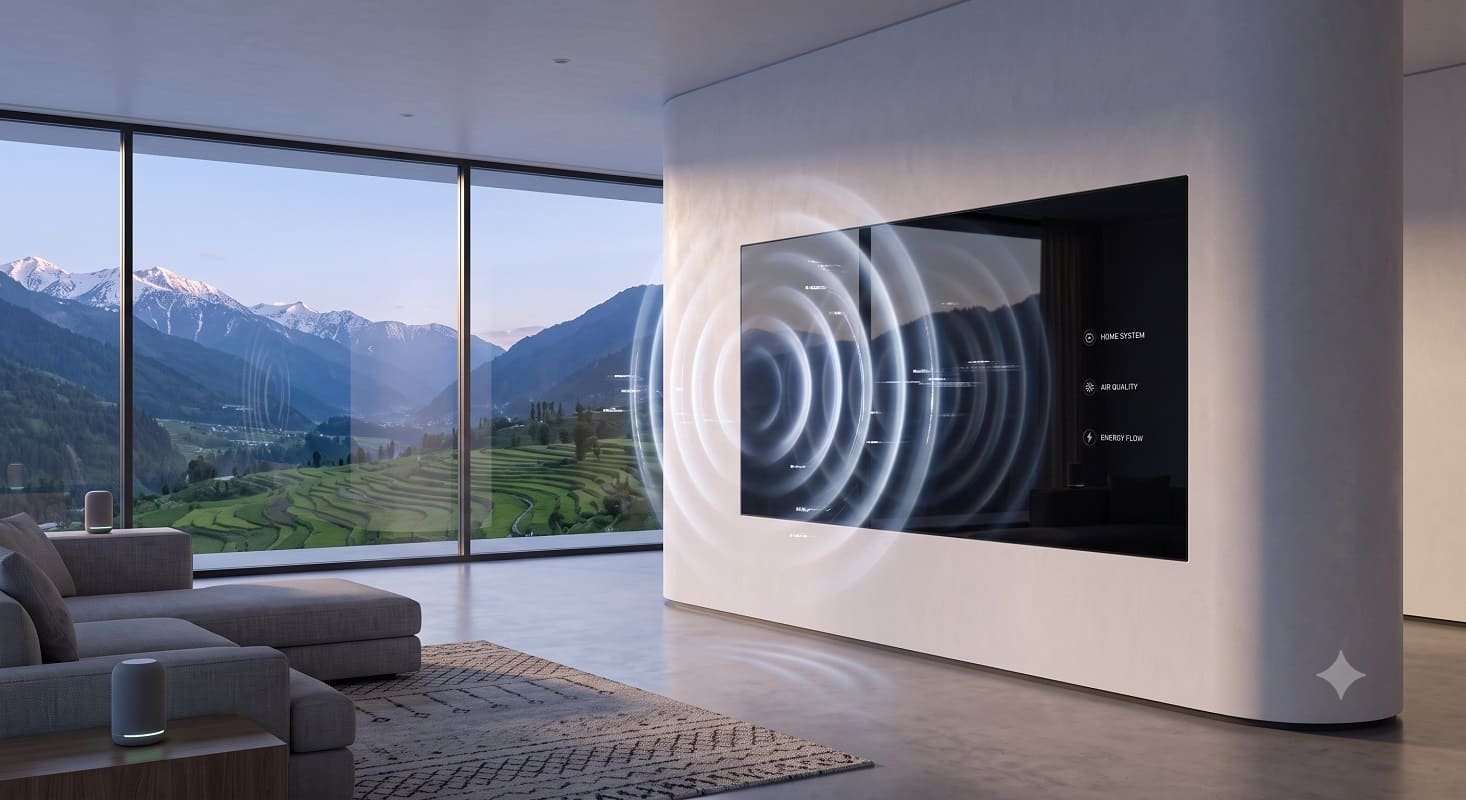
Reliance Jio is exploring intelligent reflecting surfaces designed to deliver stronger mobile coverage in locations where traditional radio signals struggle to penetrate. Showcased as part of its indigenous 6G technology stack at the India Mobile Congress 2025, these programmable panels—often referred to as “smart walls”—can redirect ambient radio waves toward areas affected by coverage gaps without generating new radio frequency transmissions.
How Reliance Jio’s Intelligent Reflecting Surface Operates
Unlike traditional base stations or small cells that actively generate electromagnetic signals, an Intelligent Reflecting Surface (IRS) consists of a flat, programmable metasurface embedded with thousands of miniature reflective elements.
The underlying principle operates similarly to an optical mirror directing light into a dark room corner. Instead of reflecting visible light, an IRS redirects incoming radio frequency waves toward targeted user devices. This capability allows high-frequency signals to bypass structural obstacles, thick concrete walls, and low-emissivity glass in dense urban environments.
| Technology Parameter | Traditional Small Cell / Repeater | Jio Intelligent Reflecting Surface (IRS) |
| Signal Generation | Active (Generates new RF signals) | Passive / Semi-Passive (Redirects existing RF signals) |
| Power Consumption | High (Typically 50W to 200W+) | Ultra-Low (Under 7 Watts) |
| Control Mechanism | Hardware Amplification | Software-Controlled Beam Steering |
| AI Integration | Standard Radio Resource Management | Real-time JioBrain AI Optimization |
| Primary Deployment Use | Capacity & Coverage Expansion | Obstacle Bypassing & mmWave/6G Propagation |
According to technical specifications disclosed by Jio, its prototype features software-controlled beam steering for dynamic signal routing. Operating at less than seven watts of power, the unit integrates JioBrain—the company’s proprietary artificial intelligence platform—to perform real-time, automated adjustments based on shifting user traffic and environmental conditions.
Addressing the High-Frequency Propagation Bottleneck
As telecommunications networks evolve from mid-band 5G toward millimeter-wave (mmWave) frequencies and future sub-terahertz 6G bands, signal propagation faces severe physical limitations. Higher frequencies offer massive data throughput but suffer from rapid atmospheric attenuation and poor penetration through physical structures.
Installing conventional cellular towers or active indoor distributed antenna systems (DAS) to solve every coverage shadow is often cost-prohibitive, power-intensive, and subject to municipal structural permissions.
Intelligent reflecting surfaces offer a complementary infrastructure layer. By turning passive building facades, billboard backings, and interior walls into active radio-guiding elements, operators can optimize radio frequency energy already present in the environment.
Global Milestones: NTT Docomo, AGC, and Orange
Jio’s development aligns India’s telecom engineering sector with ongoing global research in reconfigurable intelligent surfaces:
- NTT Docomo & AGC (Japan): In 2020, Japanese operator NTT Docomo and glass manufacturer AGC successfully tested a transparent dynamic metasurface using 28 GHz mmWave 5G signals. The design allowed reflection control while maintaining window transparency for architectural integration. In 2021, they demonstrated film-like metasurface lenses applied to windows to focus outdoor signals into indoor dead zones.
- Orange (France): In 2022, European telecom group Orange demonstrated a low-power reconfigurable intelligent surface prototype in France, positioning smart metasurfaces as a cornerstone for energy-efficient, sustainable 6G network design.
While these international projects demonstrated technological feasibility in controlled environments, large-scale commercial deployments across global networks remain in development pending standardized manufacturing and control protocols.
Expert Analysis: Commercial Viability and Industry Outlook
Industry Context: While active base stations will remain the primary backbone of mobile networks, passive and semi-passive metasurfaces represent an essential paradigm shift. By offloading signal redirection to ultra-low-power panels, operators can reduce overall energy consumption while improving high-frequency coverage density.
While Reliance Jio has not announced a firm commercial deployment timeline for its IRS technology, integrating the prototype into its 6G stack highlights India’s expanding role in global telecom intellectual property. Future adoption will depend on scaling panel manufacturing costs, establishing standardized control interfaces, and integrating smart surfaces seamlessly into operational network management software.
What This Means For Mobile Users
As smart wall technology transitions from laboratory prototypes to practical network deployments, consumers can expect long-term performance benefits:
- Elimination of Indoor Shadow Zones: Enhanced signal continuity in high-rise offices, underground transit hubs, and modern residential complexes.
- Improved Battery Life for Devices: Smartphones require less transmission power to maintain stable connections when signal paths are optimized nearby.
- Sustainable Network Infrastructure: Operators can expand network reach with minimal additions to power consumption or carbon footprints.
Reliance Jio’s exploration of Intelligent Reflecting Surfaces highlights a strategic move toward software-defined, energy-efficient network architectures. By using AI-guided beam steering to solve high-frequency signal propagation challenges, Jio’s prototype positions Indian telecom engineering at the forefront of emerging 6G research alongside global industry leaders.
