

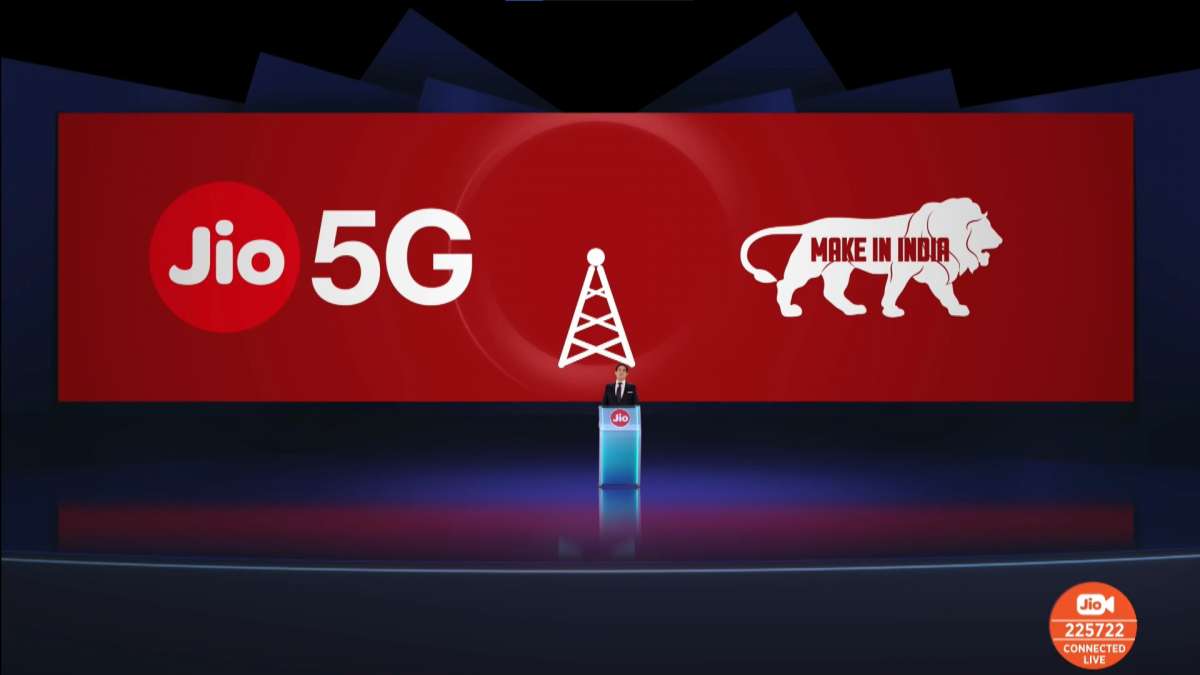
Reliance Jio enters its second decade with more than 533 million customers as 5G and AirFiber become central to its expansion.
Reliance Jio is approaching a major milestone in its telecom journey, completing 10 years of operations in India with its customer base now above 533 million. The company has grown from a disruptive 4G entrant into India’s largest connectivity platform, while its next phase is increasingly centred on 5G, fixed wireless broadband, network slicing and digital services.
Jio had 533.3 million connectivity customers as of June 30, 2026, according to Reliance Industries. The company added 35.2 million customers over the preceding 12 months, highlighting that subscriber growth has continued even after the initial phase of Jio’s market disruption.
Jio Crosses 533 Million Subscribers
Jio’s latest customer base represents one of the largest mobile subscriber pools operated by a single telecom company globally. The company had more than 524 million customers at the end of March 2026 and crossed 533 million by the end of June.
The growth has come alongside a major shift in the composition of Jio’s network. Of the 533 million connectivity customers, around 285 million were using Jio’s 5G network as of June 30, 2026.
That represents an addition of approximately 73 million 5G users over the previous 12 months. Jio has described itself as the world’s largest standalone 5G operator outside China, with 5G data traffic on its network now significantly ahead of 4G traffic.
Jio’s 10-Year Journey Moves Into a New Phase
Jio entered commercial service in 2016 and rapidly changed India’s mobile market by combining aggressive pricing with widespread 4G LTE coverage.
The company subsequently expanded beyond mobile connectivity into home broadband, entertainment, cloud, enterprise services and digital platforms. Reliance’s leadership has now positioned 5G and fixed wireless access as important parts of the company’s next stage of expansion.
At its 2026 AGM, Reliance said Jio had reached extraordinary operational scale in its first 10 years. At that point, the company reported more than 524 million users, 268 million 5G subscribers and 13 million connected homes through JioAirFiber.
The subsequent June-quarter numbers show that the expansion has continued.
JioAirFiber Reaches 14 Million Homes
Jio’s fixed broadband business is becoming an increasingly important part of its growth strategy.
As of June 30, 2026, Jio had 28.6 million fixed broadband connections, of which approximately 14 million were JioAirFiber homes. That means nearly half of Jio’s fixed broadband connections were being served through AirFiber technology.
JioAirFiber uses 5G-based fixed wireless access to deliver broadband to homes without requiring a traditional fibre connection for the final stretch.
This is particularly significant in areas where laying fibre directly to every property can be slower or more expensive. Reliance has also been deploying non-line-of-sight technology to expand the addressable market for JioAirFiber.
The company’s June-quarter commentary said the last mile is becoming more economical and time-efficient through wireless connectivity, helping drive the continued expansion of AirFiber.
5G Is Now Central to Jio’s Strategy
Jio’s next phase is not simply about adding more mobile customers. The company is increasingly focused on migrating its existing customer base toward 5G while monetising additional services built on the network.
Jio had 285 million 5G users by June 2026, up by 73 million in a year. The company also reported that 5G data traffic had reached around one-and-a-half times its 4G data traffic.
Reliance has set an ambitious longer-term target of migrating all Jio subscribers to 5G by 2030.
The company is also developing dedicated network slicing capabilities for consumers and enterprises. Network slicing can allow operators to create virtual network segments with different performance characteristics, opening the door to premium connectivity and specialised enterprise applications.
Jio’s Data Usage Continues to Rise
The growth in 5G adoption is accompanied by increasing data consumption.
Jio reported 69.4 exabytes of total data traffic during the June 2026 quarter, representing 27% year-on-year growth. Average per-capita data engagement increased to 43.7GB per user per month.
This rising usage is important for Jio because higher data consumption creates opportunities to monetise premium connectivity, entertainment, cloud services and other digital products.
Jio’s digital-services business has also been growing faster than its core connectivity business. Reliance said digital services grew around 20% year-on-year during the June quarter, supported by areas including content, cloud, IoT and managed services.
From Free Data Disruption to a Broader Digital Platform
Jio’s original market strategy centred on rapidly expanding affordable 4G access and encouraging consumers to move to its network.
Ten years later, the company is operating at a very different scale. Its strategy now encompasses mobile connectivity, 5G, fixed broadband, AirFiber, enterprise connectivity, cloud, content and other digital services.
The shift is particularly visible in Jio’s approach to network investment. Rather than treating 5G purely as a faster mobile connection, Reliance is positioning its network as infrastructure for homes, businesses and emerging digital applications.
The company’s 2026 AGM also highlighted artificial intelligence as another major growth area, with Reliance saying Jio is embedding AI across consumer technology, networks, customer service and digital platforms.
Jio’s Next Challenge Is Monetisation
Jio’s scale gives it a significant advantage, but the next phase will be less about simply acquiring subscribers and more about increasing the value generated from those customers.
Reliance has already indicated that premium 5G services, AI-bundled offerings and enterprise solutions will form part of that strategy. The company expects these value-added services to support future ARPU growth.
The upcoming Jio Platforms IPO could add another dimension to this transformation. India’s market regulator approved Jio Platforms’ proposed $3.8 billion IPO in August 2026, potentially giving investors a more direct way to value the digital-services business.
For Jio, therefore, its 10-year milestone is more than a subscriber-count achievement. The company is entering its second decade with one of the world’s largest telecom customer bases, a rapidly expanding 5G user base and a growing fixed-wireless broadband operation.
The challenge now is to turn that enormous connectivity footprint into a broader digital-services ecosystem while maintaining the affordability and network scale that helped Jio become a dominant force in India’s telecom market.
