

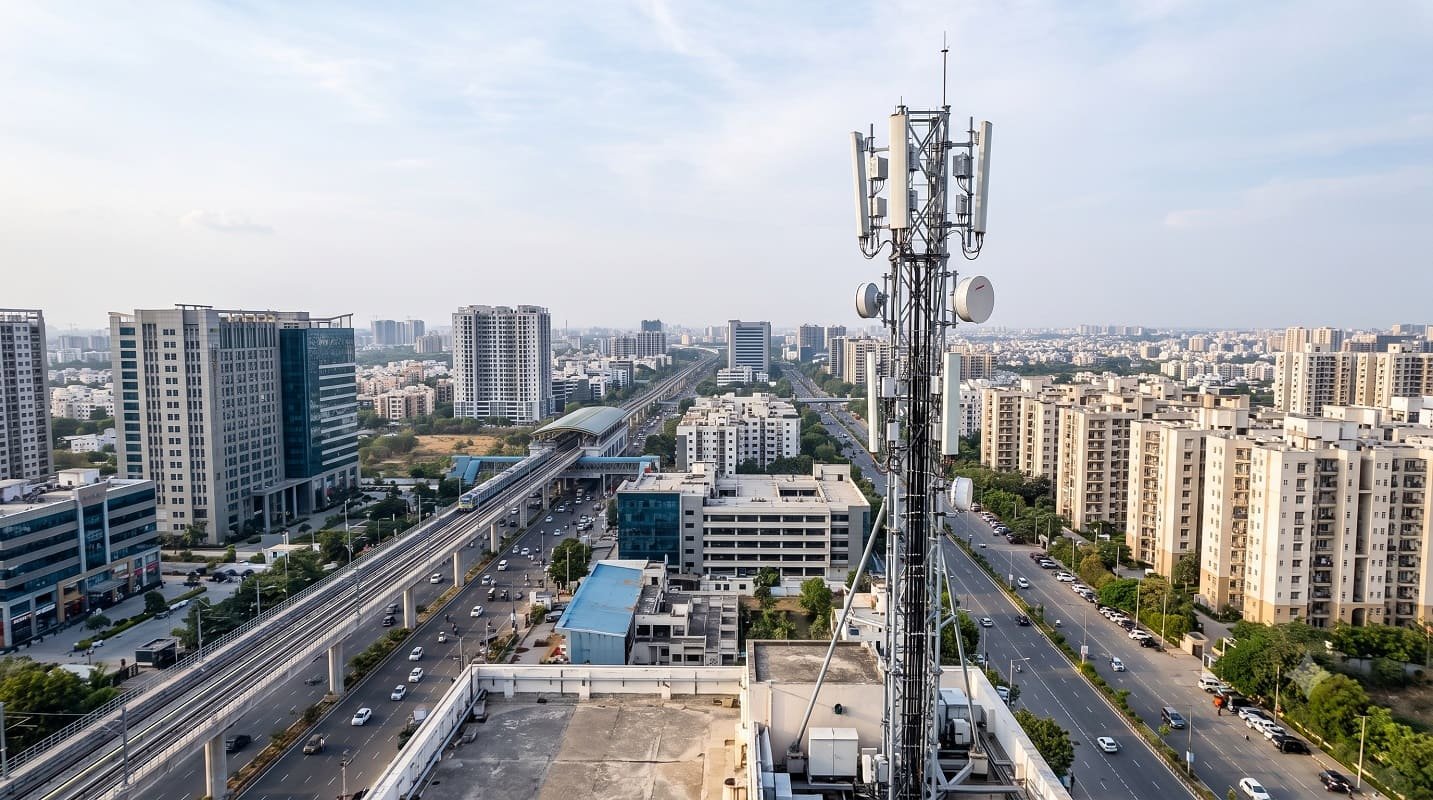
India’s three major telecom operators challenge TRAI’s proposed 5G slicing capacity benchmark as the regulator weighs consumer safeguards.
Reliance Jio, Bharti Airtel and Vodafone Idea have pushed back against the Telecom Regulatory Authority of India’s proposed quality of service rules for commercial 5G network slicing, arguing that a fixed network resource utilisation threshold could restrict how operators manage their networks.
The three major telecom operators have opposed TRAI’s proposed benchmark for Physical Resource Block (PRB) utilisation, which is intended to prevent specialised 5G network slices from affecting the quality of service available to regular users.
The dispute puts network engineering flexibility and consumer protection at the centre of India’s emerging 5G slicing framework.
Why Jio, Airtel and Vi Oppose the 80% Threshold
TRAI’s draft proposes regulatory intervention when a 5G mobile cell remains loaded above 80% during its peak hour on multiple days in a month.
The regulator’s objective is to ensure that operators maintain sufficient network capacity when dedicated 5G slices are offered to customers or enterprises. The concern is that heavily utilised cells could leave insufficient resources for ordinary users if operators prioritise specialised or premium slices.
Jio, Airtel and Vi argue that PRB utilisation is primarily an internal network parameter and does not necessarily indicate the experience that customers are receiving.
The operators have therefore called for the proposed resource-utilisation benchmarks to be removed or reconsidered, favouring quality measures based on actual consumer outcomes such as speed, throughput and latency.
Telcos Say Fixed Limits Could Increase Costs
The telecom operators are concerned that a rigid utilisation threshold could force them to add network capacity even when customers are not experiencing a meaningful degradation in service.
In areas where demand periodically approaches the proposed threshold, operators could have to deploy additional capacity or modify network configurations to remain within the regulatory framework.
According to the industry’s submissions, this could create unnecessary capital expenditure and reduce the flexibility operators currently have to optimise their networks based on local traffic patterns.
The operators also argue that network slicing is still an evolving technology, making technology-specific capacity limits potentially restrictive as 5G networks mature.
What TRAI Wants to Protect
TRAI’s proposal is aimed at addressing a different concern: ensuring that specialised 5G services do not negatively affect ordinary mobile users.
Network slicing allows an operator to create logically separated portions of a 5G network, with each slice configured for different performance requirements. For example, an enterprise could receive a slice optimised for low latency, while another service could be configured for high bandwidth or reliability.
As operators begin monetising these capabilities, consumer groups and public-interest organisations are concerned that premium services could receive preferential treatment at the expense of users on standard connectivity.
The proposed capacity safeguards are therefore intended to ensure that operators maintain sufficient resources for baseline services even when specialised slices are active.
Network Slicing Could Become a Major 5G Revenue Opportunity
The disagreement is significant because network slicing is expected to become an important way for telecom operators to monetise 5G investments.
Instead of selling connectivity purely on data speed or volume, operators can create customised network services for enterprises, industries and specialised applications.
A factory, for example, could use a dedicated slice for connected machines that requires predictable latency and reliability. Other applications could require high bandwidth or guaranteed performance.
For telecom operators, the ability to dynamically allocate network resources is therefore central to the commercial value of 5G slicing.
A rigid capacity threshold could make such services more difficult to engineer, which is why the operators are pushing TRAI towards an outcome-based approach rather than an internal network-parameter-based requirement.
TRAI’s 5G Slicing Consultation Is Still Open
The regulatory process is not yet complete. TRAI released its consultation paper on draft amendments to its Quality of Service regulations on August 5, 2026.
The consultation remains open, with the deadline for stakeholder submissions extended to September 15, 2026. The final regulations will therefore depend on TRAI’s assessment of the responses received from telecom operators, industry bodies and other stakeholders.
This means the proposed 80% PRB utilisation benchmark is not yet a final rule for Indian telecom operators.
TRAI could retain the threshold, modify it or adopt a different approach after considering the stakeholder submissions.
Jio, Airtel and Vi Face a Key Regulatory Test
The dispute highlights a broader question about how India’s 5G market should balance innovation with consumer protection.
Telecom operators want enough freedom to use network slicing as a commercial 5G service without being constrained by technical parameters that may not directly reflect customer experience.
TRAI, meanwhile, wants to ensure that the introduction of premium and specialised services does not undermine the quality of connectivity available to ordinary subscribers.
The final framework will determine how much flexibility Indian telecom operators have when commercial 5G network slicing expands.
For Jio, Airtel and Vi, the outcome could influence how quickly they can introduce new slicing-based services and how much additional network capacity they may need to deploy as those services scale.
