

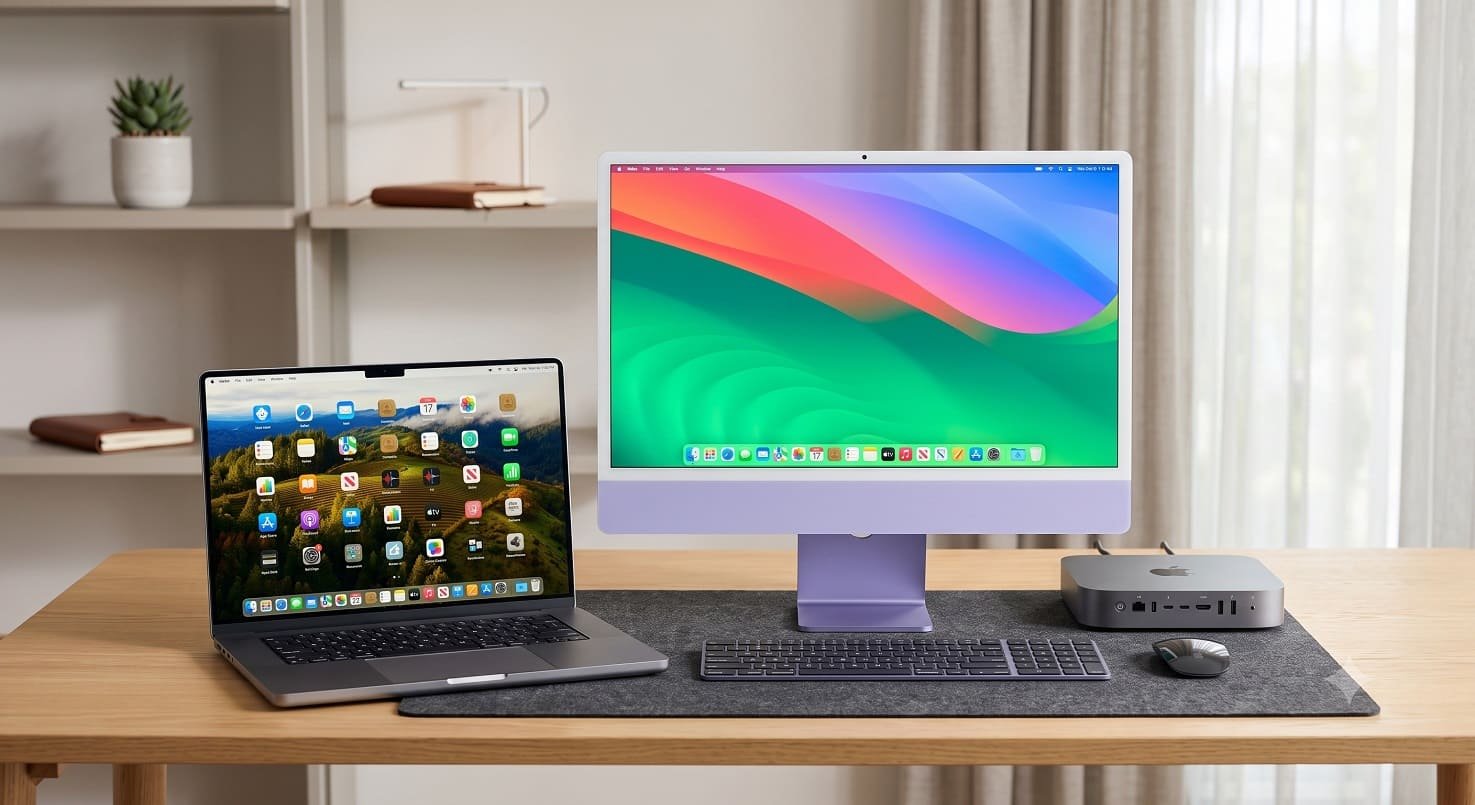
Apple is preparing a broad overhaul of its Mac product portfolio, according to a report from Bloomberg. The Cupertino-based technology company aims to capitalize on increasing consumer and enterprise demand for AI-focused hardware by updating its entire computing lineup through next year, with initial hardware releases potentially arriving before the end of this year.
M6 MacBook Pro and iMac Models Lead the Refresh Cycle
Following the rollout of M5 Pro and M5 Max processors in high-end MacBook Pro models earlier this year, Apple is shifting focus toward its next generation of Apple Silicon. Reports suggest the company may skip higher-end M6 Pro and M6 Max iterations in favor of an adjusted product schedule.
The first laptop expected to feature the baseline M6 processor is a refreshed 14-inch MacBook Pro (codenamed J804). Alongside the 14-inch laptop, Apple is reportedly developing two new iMac models (codenamed J833 and J834) powered by the same base M6 silicon. The upcoming iMac revisions may also transition toward OLED display technology to improve contrast and color accuracy.
| Mac Model | Codenamed | Expected Processor | Expected Launch Window |
| 14-inch MacBook Pro | J804 | Apple Silicon M6 | Late 2026 / Early 2027 |
| iMac Models | J833 / J834 | Apple Silicon M6 (OLED Option) | Late 2026 / Early 2027 |
| 13-inch & 15-inch MacBook Air | J913 / J915 | Apple Silicon M6 | Early 2027 |
| MacBook Neo | Unassigned | A19 Pro Bionic | 2027 |
| Mac Mini | Unassigned | M5 Pro / M6 Testing | 2027 |
| Mac Studio | Unassigned | M5 Max / M5 Ultra Testing | 2027 |
MacBook Air and the Next-Generation MacBook Neo
Apple’s popular consumer laptops are also slated for updates. The 13-inch and 15-inch MacBook Air models (codenamed J913 and J915) are expected to receive internal spec bumps early next year, retaining their existing thin-and-light industrial design while adopting newer silicon.
For the budget segment, Apple is working on a follow-up to its most affordable laptop, the MacBook Neo. While the current entry model leverages an A-series chip, the upcoming revision is expected to adopt an A19 Pro processor with expanded memory options and new personalization colorways. This move aims to deliver improved local machine learning performance without escalating manufacturing costs to traditional M-series levels.
Desktop Strategy: Mac Mini and Mac Studio Developments
On the desktop front, Apple is actively testing multiple silicon configurations to determine optimal thermal and performance balances:
- Mac Mini: Internal testing includes builds configured with the M5 Pro as well as the base M6 processor, aimed at maintaining a compact footprint for desktop users.
- Mac Studio: Higher-performance desktop testing involves the M5 Max and top-tier M5 Ultra chipsets, targeting creative professionals and software engineers requiring high unified memory bandwidth for large AI models.
Expert Analysis: Leveraging Silicon to Drive AI Hardware Demand
Industry Context: The ongoing expansion of local generative AI tools and on-device machine learning frameworks has altered PC buying habits. By updating its hardware stack across both A-series and M-series chips, Apple is positioning its Mac family to execute complex AI tasks natively on device.
While Apple has not officially confirmed launch dates or hardware configurations, aligning desktop and laptop updates with updated neural engine architectures remains central to its long-term personal computing strategy.
What This Means For Mac Users
For current Mac owners and prospective buyers, the reported lineup overhaul provides clear direction for upcoming upgrade decisions:
- Near-Term Stability for M5 Owners: Users who recently purchased M5 Pro or M5 Max MacBook Pro models hold current-generation hardware, as high-end M6 variants are reportedly being bypassed in the immediate cycle.
- Accessible Entry Points: The planned A19 Pro upgrade for the MacBook Neo will provide budget-conscious users and students with capable local AI processing without paying premium prices.
- Display Improvements: Desktop users waiting for an all-in-one upgrade may soon see OLED technology transition from the iPad Pro lineup into desktop iMac displays.
Apple’s reported plan to refresh its Mac portfolio highlights a clear strategic pivot toward meeting AI-driven performance needs across every price point. By pairing new M6 processors with a more capable A19 Pro-powered MacBook Neo, Apple is ensuring that both everyday consumers and creative professionals have access to updated silicon capable of handling next-generation computing workloads.
