

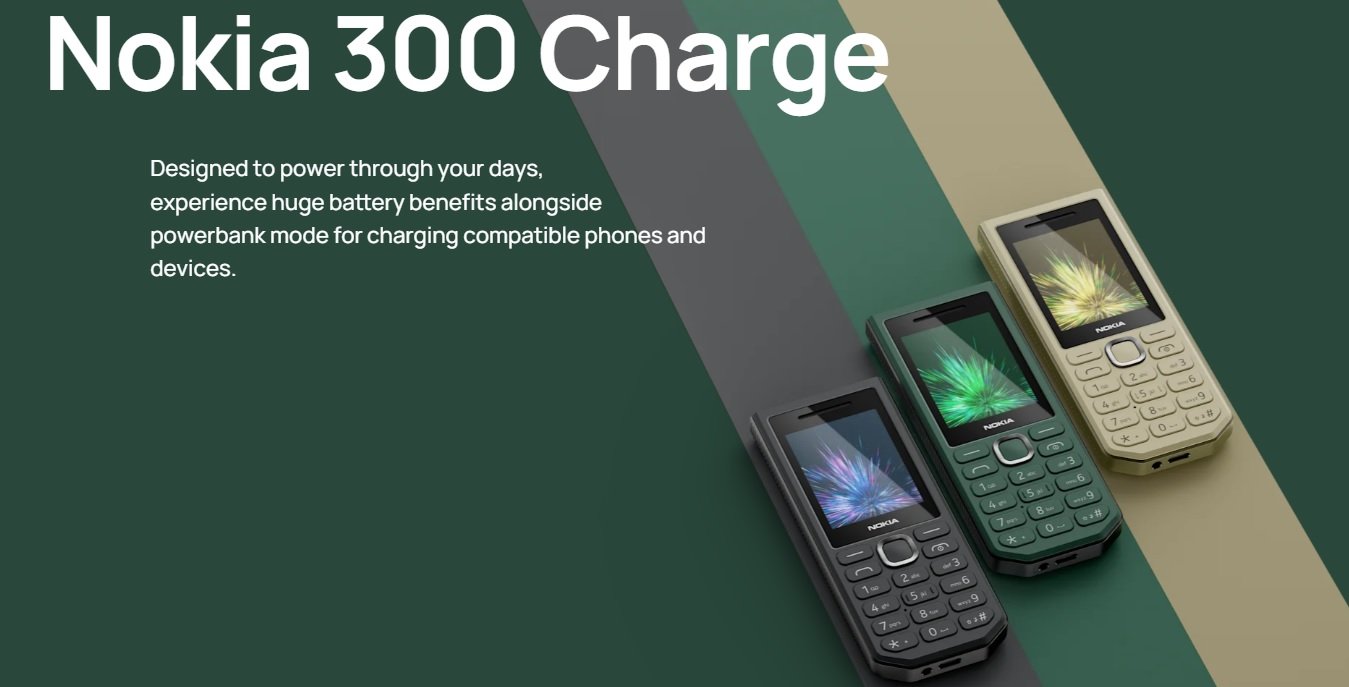
Nokia 300 Charge brings an unusually large 3,700mAh removable battery and 10W reverse charging to the feature phone segment.
The Nokia 300 Charge has been launched as a feature phone with an unusual capability that is rarely seen in this segment: reverse charging. HMD’s latest Nokia-branded phone combines a large 3,700mAh removable battery with a dedicated physical button that activates reverse charging, allowing the handset to provide power to another compatible device.
The Nokia 300 Charge has been announced in the Philippines and targets users looking for long battery life, basic communication features and a rugged form factor rather than a full-fledged smartphone experience.
The phone also features a dedicated torch positioned on the top of the handset. HMD says this is a proper torch rather than simply using the LED associated with the rear camera.
Nokia 300 Charge Price and Availability
The Nokia 300 Charge has been launched in the Philippines at PHP 2,190, which converts to approximately Rs 3,400 based on the price information provided.
The feature phone is offered in three colour options:
- Black
- Green
- Sandstone
HMD has not indicated in the supplied information whether the Nokia 300 Charge will be launched in India.
This is important for Indian buyers because Nokia-branded feature phones continue to have recognition in the country, particularly among consumers who prefer simple handsets with long battery life.
For now, the Philippines is the confirmed launch market based on the available information.
Nokia 300 Charge Gets a 3,700mAh Removable Battery
The biggest highlight of the Nokia 300 Charge is its 3,700mAh battery.
That is an unusually large capacity for a traditional feature phone.
The battery is also removable, giving users the ability to replace it rather than relying on a permanently integrated battery.
HMD claims the handset can deliver up to 37 hours of talk time and up to 40 days of standby time.
Actual battery performance will depend on network conditions, calling patterns and other usage factors, but the specifications indicate that the phone is designed primarily for endurance.
The large battery could make the Nokia 300 Charge particularly useful for people travelling for extended periods or users who do not want to recharge their phone frequently.
Nokia 300 Charge Adds 10W Reverse Charging
The Nokia 300 Charge gets its name from one of its most unusual features.
HMD has added a physical button on the right side of the handset that activates reverse charging.
The feature allows the phone to act as a basic power source for another compatible device.
The handset uses a USB Type-C port for charging its own battery as well as enabling the 10W reverse charging function.
This means the Nokia 300 Charge can effectively work as a small emergency power source when another device requires additional battery capacity.
It is not intended to replace a conventional power bank, but the functionality could be useful in situations where a user has no access to a charger or power socket.
The combination of a 3,700mAh removable battery and reverse charging makes the Nokia 300 Charge particularly different from conventional feature phones.
Nokia 300 Charge Has a Rugged Design
The Nokia 300 Charge has a rugged-looking body designed for users who prioritise durability and practical functionality.
The handset measures 136.55 x 55 x 14.94mm and weighs 138 grams.
Its thickness is considerably greater than most modern smartphones, but that is understandable given the removable high-capacity battery and traditional feature phone construction.
The phone also includes a dedicated torch at the top.
HMD specifically describes the light as a proper torch rather than a standard camera flash, suggesting that it is designed to provide more useful illumination when needed.
For users who work outdoors, travel frequently or spend time in areas with unreliable electricity, the combination of long battery life and a dedicated torch could be more practical than many entry-level smartphones.
Nokia 300 Charge Features a 2.4-Inch Display
The Nokia 300 Charge features a 2.4-inch QVGA display.
As expected from a traditional feature phone, the device does not offer a touchscreen smartphone-style interface.
The screen is intended for basic functions such as calling, messaging, contacts and other features supported by the phone’s operating system.
The handset also includes a QVGA-resolution rear camera.
Camera quality is unlikely to be the primary reason consumers choose the Nokia 300 Charge, given its basic hardware configuration and feature phone positioning.
Instead, the camera is an additional utility for users who occasionally want to capture basic images.
Nokia 300 Charge Uses S30+ Software
The Nokia 300 Charge runs HMD’s S30+ software platform.
The operating system is designed specifically for feature phones and does not provide the same app ecosystem or functionality found on Android smartphones.
The handset is powered by a Unisoc SC6531E chipset.
It comes with:
- 4MB RAM
- 4MB internal storage
- microSD card support up to 32GB
- S30+ software
- QVGA display
- QVGA rear camera
The extremely low memory and storage specifications highlight the difference between the Nokia 300 Charge and even basic Android smartphones.
The phone is built to perform essential tasks rather than run demanding applications.
Nokia 300 Charge Supports Only 2G
One of the most important specifications of the Nokia 300 Charge is its network connectivity.
The handset supports only GSM 900/1800 2G bands.
There is no 4G connectivity listed for the device.
This limits its relevance in markets where 2G networks have been substantially reduced or are being phased out. However, 2G remains operational in several markets and can still provide basic voice and SMS connectivity.
For Indian consumers, network compatibility will be particularly important if HMD eventually launches the Nokia 300 Charge locally.
Indian telecom operators have expanded 4G and 5G networks significantly, while 2G continues to serve a large base of feature-phone users. Any potential Indian launch would therefore need to consider the long-term availability of compatible networks.
Nokia 300 Charge Is More About Utility Than Smart Features
The Nokia 300 Charge takes a very different approach from today’s smartphones.
Instead of focusing on high-resolution displays, multiple cameras, 5G connectivity or AI capabilities, HMD has prioritised:
- Large battery capacity
- Removable battery
- Reverse charging
- Dedicated torch
- Physical controls
- Rugged construction
- Long standby time
This makes the Nokia 300 Charge a utility-focused device.
For some users, these features could be more valuable than smartphone functionality.
A user travelling to a remote location, for example, could benefit from a phone that lasts for several days and can provide emergency power to another device.
Nokia 300 Charge vs Modern Feature Phones
The Nokia 300 Charge arrives at a time when feature phones are becoming more specialised.
HMD has recently introduced several Nokia-branded feature phones, including the Nokia 235 4G (2026), Nokia 215 4G (2026), Nokia 210 4G and Nokia 200 4G in select markets.
Several of these newer models focus on bringing modern connectivity or AI-related functionality to traditional feature phone designs.
The Nokia 300 Charge, by contrast, focuses heavily on battery and utility.
Its dedicated reverse charging button is particularly distinctive.
This could help the phone stand out in a market where conventional feature phones often compete primarily on price, battery life and durability.
Nokia Is Also Exploring AI Feature Phones
The Nokia 300 Charge is not the only recent Nokia-branded feature phone development.
HMD has also introduced several AI-focused feature phones in selected global markets.
The Nokia 235 4G (2026), Nokia 215 4G (2026), Nokia 210 4G and Nokia 200 4G include an AI assistant button designed to provide access to various functions using voice commands.
This suggests HMD is experimenting with two different directions for the feature phone market.
One approach is adding smarter software and AI capabilities, while another is improving traditional hardware features such as battery life and emergency functionality.
The Nokia 300 Charge clearly falls into the second category.
Could Nokia 300 Charge Launch in India?
The Nokia 300 Charge has currently been announced for the Philippines, and there is no confirmed Indian launch information in the supplied details.
If HMD eventually brings the device to India, pricing and network compatibility will be critical factors.
The approximately Rs 3,400 equivalent price in the Philippines places the phone in the affordable feature phone segment.
However, Indian buyers would likely compare it against 4G feature phones because of the increasing importance of 4G connectivity.
The lack of 4G could become a significant disadvantage if customers are looking for a future-proof feature phone.
On the other hand, its 3,700mAh battery, 10W reverse charging and dedicated torch could make it attractive as a secondary or emergency handset.
Nokia 300 Charge: Who Is It For?
The Nokia 300 Charge is not designed to replace a smartphone.
Instead, its strongest appeal is likely to come from users who need basic connectivity with exceptional battery endurance.
The phone could appeal to:
- Users who primarily make voice calls.
- People who want a secondary handset.
- Travellers who need long battery life.
- Users who want an emergency backup phone.
- Consumers who value a removable battery.
- People looking for a basic handset with a built-in torch.
- Users who occasionally need emergency reverse charging.
The phone’s 2G-only connectivity and basic software significantly restrict its use for smartphone-style applications.
However, those limitations are less important for someone who simply wants a reliable calling device.
Nokia 300 Charge Could Be a Useful Emergency Phone
The Nokia 300 Charge stands out because its features are designed around real-world utility rather than specifications alone.
A 3,700mAh battery is substantial for a feature phone. Adding reverse charging turns that battery into an emergency power source, while the dedicated torch adds another practical function.
The phone also retains a removable battery, which is increasingly uncommon in modern smartphones.
For users in areas where charging infrastructure can be unreliable, these features could make a meaningful difference.
However, the 2G-only connectivity means potential buyers should first confirm that their local operator continues to provide reliable 2G voice service.
Final Verdict
The Nokia 300 Charge is an unusual feature phone that puts battery endurance and utility ahead of smart features.
Its 3,700mAh removable battery, claimed 37-hour talk time, 40-day standby capability, dedicated torch and 10W reverse charging make it significantly different from conventional basic handsets.
The biggest limitation is its 2G-only connectivity, particularly for markets such as India where 4G feature phones are becoming increasingly relevant.
At approximately Rs 3,400 in the Philippines, the Nokia 300 Charge could appeal to consumers looking for a rugged secondary phone or emergency device rather than a smartphone replacement.
For now, however, Indian buyers will have to wait for confirmation from HMD regarding any India launch.
