

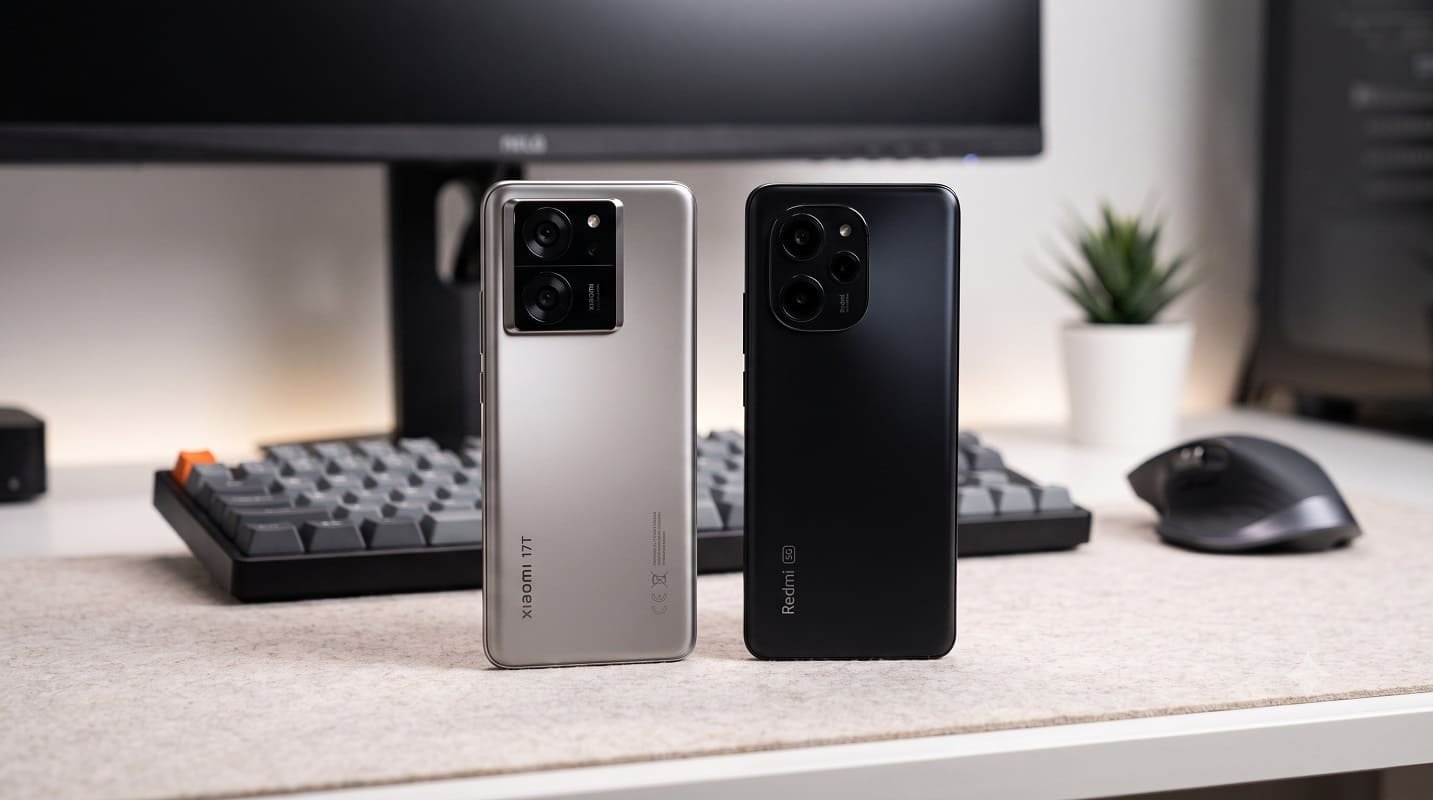
The Redmi Note 17 Pro and Pro Max share the same core design language but differ significantly in processor, memory, cameras, battery capacity and charging.
Xiaomi’s Redmi has expanded its Note 17 series with the Redmi Note 17 Pro 5G and Redmi Note 17 Pro Max 5G. The two smartphones share a similar design and several core features, but the Pro Max version brings meaningful upgrades in processing power, memory, cameras, battery capacity and charging.
The Redmi Note 17 series was launched in selected markets on August 27, 2026. While the Indian pricing of the two Pro models has not yet been announced, the specifications provide a clear picture of how Redmi has positioned the Pro Max above the standard Pro model.
Redmi Note 17 Pro vs Pro Max: Design
The Redmi Note 17 Pro 5G and Redmi Note 17 Pro Max 5G follow a similar design language, with both smartphones featuring a flat display and a vertically arranged dual-camera system on the rear.
The Note 17 Pro comes with a plastic frame and rear panel, while the front is protected by Corning Gorilla Glass Victus 2. The phone features rounded corners and a matte-style finish that gives it a more premium appearance despite the use of a plastic frame and back.
The Note 17 Pro Max also uses a plastic frame and rear panel with Gorilla Glass Victus 2 protection on the front. Its rear camera module follows a similar vertical arrangement, although the positioning of the flash and other visual elements differs slightly from the Pro model.
Both smartphones also carry IP68/IP69K ratings for water and dust resistance. This gives the phones additional protection against dust, immersion and high-pressure water exposure.
Redmi Note 17 Pro vs Pro Max: Display
Both smartphones feature a 6.83-inch 1.5K AMOLED display with a 120Hz refresh rate. This means users get a large, high-resolution panel with smoother scrolling and animations compared with conventional 60Hz displays.
The Redmi Note 17 Pro offers support for 68 billion colours, a claimed peak brightness of up to 3,500 nits and a 240Hz touch sampling rate. These specifications make the panel suitable for gaming, video consumption and general everyday use.
The Redmi Note 17 Pro Max retains the same 6.83-inch 1.5K AMOLED format and 120Hz refresh rate, while adding HDR10+ and Dolby Vision certification. It also supports a 240Hz touch sampling rate and DCI-P3 colour gamut coverage.
For users who spend considerable time watching HDR content, the Pro Max therefore has the more feature-rich display package.
Redmi Note 17 Pro vs Pro Max: Processor
One of the key differences between the two smartphones is the chipset.
The Redmi Note 17 Pro 5G is powered by Qualcomm’s Snapdragon 6S Gen 4, a 4nm mid-range processor. The chipset uses four Cortex-A78 cores clocked at up to 2.4GHz and four Cortex-A55 cores running at up to 1.8GHz.
The Redmi Note 17 Pro Max 5G moves to the Snapdragon 6 Gen 5. It is also manufactured using a 4nm process but offers higher clock speeds, with four Cortex-A78 cores reaching up to 2.6GHz and four Cortex-A55 cores running at up to 2.0GHz.
Based on the benchmark figures provided for the two chipsets, the Snapdragon 6 Gen 5 has an advantage in both overall performance and multi-core processing. This should make the Pro Max the more capable option for demanding applications and gaming.
However, benchmark results can vary depending on software versions, thermal conditions and individual testing environments. They should therefore be treated as performance indicators rather than guaranteed real-world results.
RAM and Storage
The memory configuration also gives the Redmi Note 17 Pro Max an advantage.
The Redmi Note 17 Pro 5G is available with up to 12GB of LPDDR4X RAM. Storage options extend up to 512GB, with the higher-capacity variants using faster UFS 3.1 storage.
The Pro Max upgrades to LPDDR5X RAM with up to 12GB capacity and offers up to 512GB of storage. Higher-capacity configurations use UFS 4.1, while the entry-level 128GB configuration uses UFS 2.2.
The faster memory and storage technologies on the Pro Max should provide improved application loading and file-transfer performance, particularly on the higher-storage variants.
Redmi Note 17 Pro vs Pro Max: Camera
The camera hardware is another area where the two smartphones are relatively similar but not identical.
The Redmi Note 17 Pro features a dual-camera setup consisting of a 50MP primary sensor with OIS and an 8MP ultra-wide camera. The ultra-wide camera offers a 120-degree field of view.
For selfies, the Pro model features a 16MP front-facing camera with an f/2.4 aperture.
The Redmi Note 17 Pro Max also features a 50MP primary camera and an 8MP ultra-wide sensor. However, the main camera uses a wider f/1.5 aperture, which could potentially help with low-light photography by allowing more light to reach the sensor.
The biggest front-camera upgrade comes with the Pro Max, which features a 32MP selfie camera with an f/2.2 aperture.
On paper, the Pro Max therefore has the more capable camera package, particularly for users who regularly take selfies or shoot in challenging lighting conditions.
Battery and Charging
Battery capacity is arguably the biggest hardware difference between the two models.
The Redmi Note 17 Pro 5G packs an 8,340mAh silicon-carbon battery with support for 67W HyperCharge wired charging. It also supports 22.5W reverse wired charging.
Redmi has included the Xiaomi Surge G1 Battery Management Chip to help manage battery performance and temperature.
The Redmi Note 17 Pro Max takes the battery specification considerably further. It features a massive 10,000mAh silicon-carbon battery and supports 100W HyperCharge wired charging.
The Pro Max also supports 27W wired reverse charging and includes the Xiaomi Surge G1 Battery Management Chip.
For users prioritising battery endurance, the Pro Max is clearly the more ambitious option. Its 10,000mAh capacity could make it particularly attractive to heavy users, gamers and people who spend long periods away from a charger.
Software and AI Features
Both smartphones run HyperOS 3 based on Android 16. Redmi has also promised five major Android OS upgrades and six years of security updates for the devices.
If the stated update policy is maintained, both phones could receive software and security support well into 2032. This gives the devices a longer expected software lifecycle than many smartphones in the mid-range segment.
The two models also include Google’s Gemini integration and a collection of AI-powered image and search features.
These include AI Erase Pro, AI Glare Removal, AI Image Expansion, AI Sky, AI Bokeh, AI Image Enhancement, AI Beautify and Circle to Search with Google, alongside Gemini functionality.
Redmi Note 17 Pro vs Pro Max: India Price
Redmi has not yet announced the India prices of the Redmi Note 17 Pro 5G and Redmi Note 17 Pro Max 5G.
The Redmi Note 17 series is expected to expand into India, but the company will need to confirm the launch schedule and pricing before buyers can determine the value proposition of each model in the Indian market.
For context, the Redmi Note 17 Pro launched in selected markets at a starting price of Rs 27,999. This does not represent the confirmed Indian price, and the final India pricing could differ depending on the configuration and market positioning.
Redmi is scheduled to launch the Redmi 17 5G in India on September 3, 2026, and the company could reveal additional information about the broader Note 17 lineup around the Indian launch.
Redmi Note 17 Pro vs Pro Max: Which One Should You Buy?
The Redmi Note 17 Pro 5G is aimed at buyers who want a large AMOLED display, capable mid-range performance, a 50MP OIS camera and a large battery without moving to the highest-end configuration.
The Redmi Note 17 Pro Max 5G is designed for users who want more performance and endurance. Its Snapdragon 6 Gen 5 chipset, LPDDR5X RAM, faster storage options, 32MP selfie camera, 10,000mAh battery and 100W charging make it the more powerful device of the two.
The Pro Max is therefore the obvious choice for buyers who prioritise battery life, charging speed, performance and higher-end specifications. The standard Pro could make more sense for buyers who want most of the flagship-style features while keeping the eventual purchase price lower.
The final decision, however, will depend heavily on India’s pricing. If Redmi maintains a relatively narrow price gap between the two models, the Pro Max could offer considerably better value because of its larger battery, faster charging and upgraded hardware.
If the price difference is substantial, the standard Note 17 Pro could become the more attractive option for buyers who do not need the additional performance and battery capacity.
Redmi Note 17 Pro vs Pro Max: Key Differences
| Feature | Redmi Note 17 Pro 5G | Redmi Note 17 Pro Max 5G |
|---|---|---|
| Display | 6.83-inch 1.5K AMOLED, 120Hz | 6.83-inch 1.5K AMOLED, 120Hz |
| Peak brightness | Up to 3,500 nits | Not specified |
| Processor | Snapdragon 6S Gen 4 | Snapdragon 6 Gen 5 |
| RAM | Up to 12GB LPDDR4X | Up to 12GB LPDDR5X |
| Storage | Up to 512GB | Up to 512GB |
| Main camera | 50MP, OIS | 50MP, OIS |
| Ultra-wide | 8MP, 120-degree | 8MP |
| Selfie camera | 16MP | 32MP |
| Battery | 8,340mAh | 10,000mAh |
| Wired charging | 67W | 100W |
| Reverse charging | 22.5W | 27W |
| Software | HyperOS 3, Android 16 | HyperOS 3, Android 16 |
| Water/dust resistance | IP68/IP69K | IP68/IP69K |
| India price | Not announced | Not announced |
The Redmi Note 17 Pro vs Pro Max comparison shows that Redmi has created a clear hardware hierarchy between the two smartphones. While the basic design and display experience remain similar, the Pro Max gains meaningful upgrades in processing, memory technology, front camera, battery capacity and charging.
For Indian buyers, the final verdict will largely depend on the official pricing and availability. Until Redmi confirms those details, the Pro Max appears to be the more feature-rich option, while the standard Pro could deliver a more balanced package if priced competitively.
