

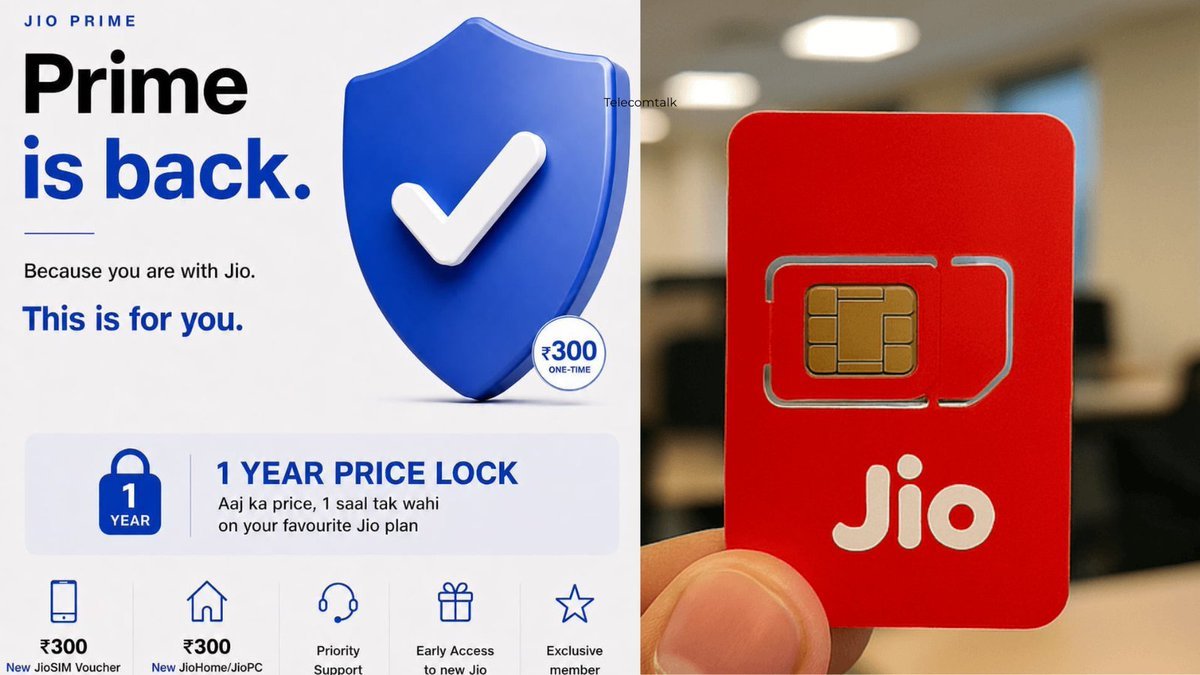
Jio’s revived Prime membership offers tariff protection through September 2027, but early consumer feedback suggests limited awareness.
Reliance Jio’s revamped Prime membership appears to be struggling to generate widespread consumer interest, at least based on early feedback from users. The Rs 300 Prime membership was introduced in August with a key promise: customers could continue using eligible Jio recharge plans at their existing prices until September 5, 2027, even if the operator raises tariffs during that period.
However, early anecdotal feedback suggests that many Jio users are either unaware of the new Prime membership or do not see an immediate reason to pay Rs 300 for it. There is currently no official subscriber data from Jio showing how many customers have purchased the membership, so it would be premature to call the programme a failure.
What Is Jio Prime Rs 300 Plan?
Jio brought back its Prime membership in August 2026 after several years. Unlike the original Jio Prime programme, which was introduced at a much lower Rs 99 price, the revamped membership requires a one-time Rs 300 payment.
The main benefit is a price guarantee on eligible Jio recharge plans. According to Jio’s official terms, customers who purchase the Prime membership can continue recharging an eligible plan at its locked price until September 5, 2027, even if Jio increases the price of that plan during the guarantee period.
The guarantee is tied to the eligible recharge plan that is active when the customer opts for Jio Prime. It does not apply to every Jio product or recharge category. Jio specifically excludes top-ups, standalone data add-ons, international roaming packs and ISD recharges from the price guarantee.
Why Are Users Not Rushing to Buy Jio Prime?
The biggest problem for the Rs 300 Prime membership may be the lack of urgency.
Jio has not announced a tariff increase that customers need to protect themselves against immediately. As a result, users can continue buying their existing eligible plans at their current prices without paying the additional Rs 300 membership fee.
This makes the value proposition largely dependent on what happens to Jio’s tariffs in the coming months.
If Jio increases the price of a popular recharge plan significantly, Prime customers could potentially benefit from the locked price. But if tariff increases are delayed or remain modest, customers may not feel that they received enough value from paying the upfront membership fee.
Early feedback reported by TelecomTalk’s editor also suggests that awareness could be another challenge. The publication’s author said that people he contacted were generally not opting for the membership and that some users were not even aware that Jio Prime had returned.
That is an observation from an informal sample, however, rather than a statistically representative survey of Jio’s subscriber base.
Jio Prime Is Different From the Original Rs 99 Membership
The original Jio Prime membership was launched when Jio was building its customer base and offered users access to preferential tariffs and benefits for a relatively small annual fee.
The current programme has a different purpose.
Jio is already a mature telecom operator with hundreds of millions of subscribers. Instead of using Prime primarily as a customer-acquisition tool, the new Rs 300 membership is designed around tariff protection and customer retention.
Jio’s decision to bring back Prime also came as India’s telecom operators continued to face pressure to increase average revenue per user and prepare for another potential tariff-revision cycle.
Financial Express reported that analysts viewed the price guarantee as potentially signalling another tariff increase ahead, although the timing and size of any future industry-wide hike remain uncertain.
The Rs 299 Plan Makes the Offer More Interesting
One of the biggest reasons behind the return of Jio Prime is the continuation of the Rs 299 prepaid plan.
Jio confirmed that eligible customers can continue using the Rs 299 plan, while the Prime membership allows them to lock its price during the guarantee period. The Rs 299 plan offers 1.5GB of daily data for 28 days along with bundled benefits.
For a customer who regularly uses the Rs 299 recharge, the calculation is relatively simple.
If Jio raises the price of the plan substantially during the guarantee period, the Rs 300 Prime fee could potentially be recovered through the difference between the old and new recharge prices. But customers who do not expect a significant tariff increase may prefer to keep the Rs 300 in their bank account and continue recharging normally.
That uncertainty makes the membership more of a bet on future tariffs than an immediately visible discount.
Jio Has Added More Benefits
Jio Prime is not limited to tariff protection.
According to Jio’s current terms, the membership includes cashback vouchers linked to new Jio mobile, JioHome and JioPC connections. Customers can receive three Rs 100 cashback vouchers for a new Jio mobile connection, along with separate Rs 100 vouchers associated with new JioHome and JioPC connections, subject to the applicable conditions.
Jio also lists priority customer support, including on-demand callback services, and early access to selected new Jio products and services.
The vouchers are credited to the customer’s MyJio account within seven days of a successful Prime recharge and have to be redeemed within seven months. They cannot simply be combined into one Rs 300 discount.
These additional benefits could improve the overall value of Prime for customers who are already considering a new Jio connection or JioHome service.
For an existing mobile-only customer who has no plans to purchase additional Jio services, however, much of that value may remain unused.
The Real Test Will Come With the Next Tariff Hike
The success of Jio Prime may ultimately depend on when and how Jio changes its tariffs.
If recharge prices rise substantially before September 5, 2027, Prime members could have a clear financial advantage because they can continue using their locked eligible plans at the previous price.
For example, a customer who currently pays Rs 299 for an eligible recharge could potentially save more than the Rs 300 membership cost if the same recharge becomes substantially more expensive during the guarantee period and the customer continues using it frequently.
But the opposite is also possible.
If Jio does not raise the price significantly, or if a customer switches to another recharge plan that is not covered by the guarantee, the financial benefit could be limited.
This makes the Rs 300 Prime membership different from a conventional discount or cashback offer. Its value depends heavily on future pricing decisions.
Awareness Could Be Jio Prime’s Bigger Challenge
The early feedback raises another question: whether Jio has done enough to communicate the programme to its enormous customer base.
Jio has a very large prepaid subscriber base, but a large proportion of customers may simply recharge their phones through familiar channels without closely following telecom-industry announcements.
The Prime membership requires customers to understand a future benefit: pay Rs 300 now to protect the price of eligible plans for more than a year.
That is less immediately tangible than a recharge offering extra data, OTT subscriptions or additional validity.
Jio’s own terms also make clear that the price guarantee has conditions and applies only to eligible recharge plans.
For the membership to gain broader adoption, customers may need to clearly understand which plan they are locking and how much they could potentially save if tariffs increase.
Too Early to Call Jio Prime a Failure
The available evidence does not establish that Jio Prime has failed to attract customers.
The Rs 300 membership was only recently introduced, and Jio has not disclosed its subscriber numbers or conversion rate. The observation that people contacted by one publication did not show much interest provides an early signal, but it cannot be treated as representative of Jio’s entire customer base.
The programme will be easier to evaluate once Jio provides information about Prime subscriptions or once a broader set of consumer data becomes available.
For now, the more accurate conclusion is that Jio Prime has not yet created an obvious sense of urgency among some customers.
Jio Prime’s Value Depends on What Happens Next
Jio’s Rs 300 Prime membership is essentially a price-protection product. Its value will become clearer when the next major tariff revision arrives.
Customers who regularly use an eligible Jio plan and expect prices to rise could find the guarantee useful. Those who are uncertain about their future recharge requirements may prefer to wait rather than pay an upfront membership fee.
The early lack of visible consumer excitement therefore does not necessarily mean Jio Prime is unsuccessful. It could simply reflect the nature of the offer: customers are being asked to pay today for protection against a price increase that may happen sometime in the future.
For Jio, the bigger challenge may be turning that future-oriented benefit into something millions of existing customers immediately understand and consider worth paying Rs 300 for.
