

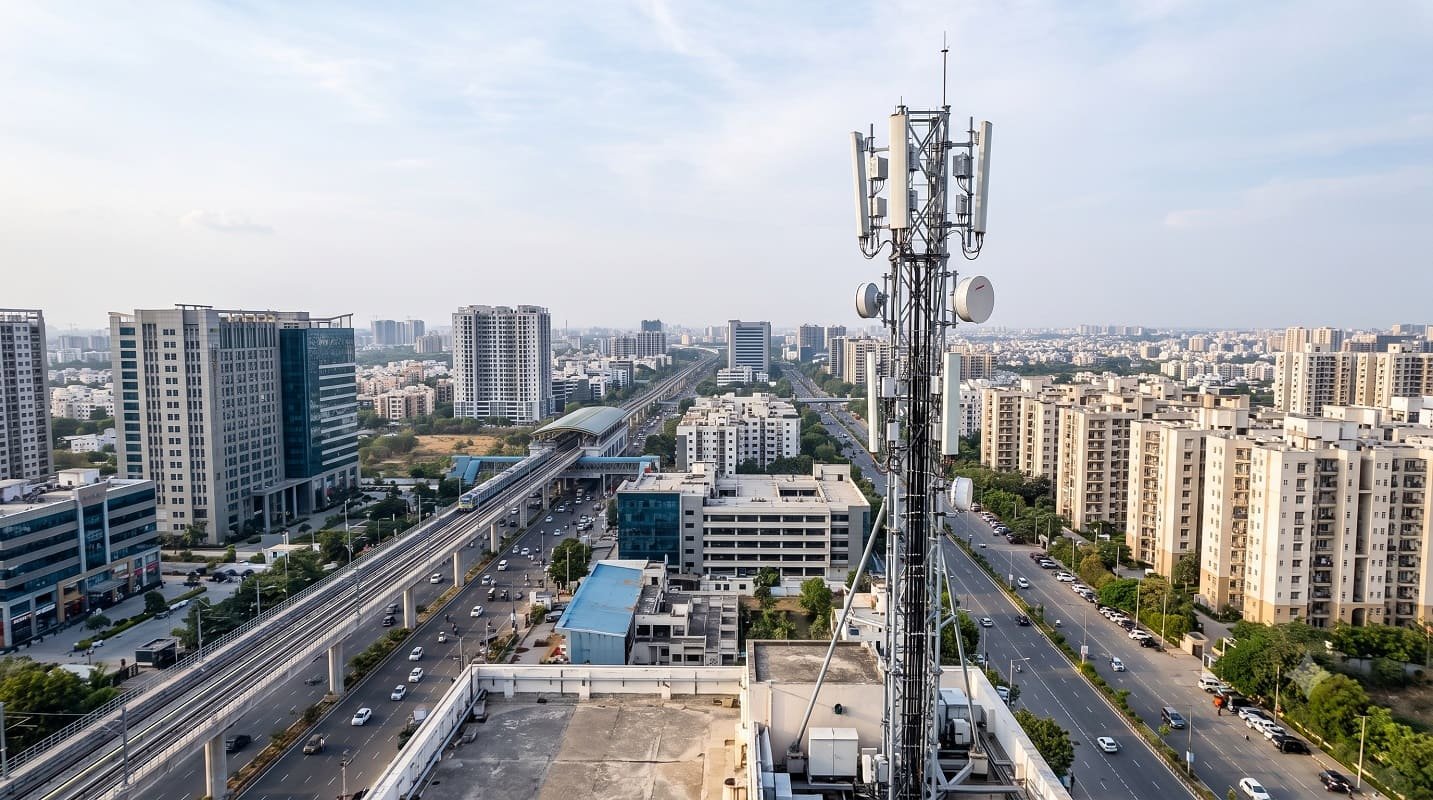
India’s 5G adoption reaches a major milestone as Jio and Airtel together account for around 100 million users.
India 5G users have crossed the 100 million mark, highlighting the rapid adoption of next-generation mobile connectivity across the country. Reliance Jio and Bharti Airtel account for the overwhelming majority of this user base, with approximately 62 million and 38 million 5G users respectively.
The milestone represents an important stage in India’s 5G journey. Operators are now moving beyond the initial network rollout phase and focusing increasingly on converting 5G availability into regular consumer usage, higher data consumption and new digital services.
It also reinforces the position of Jio and Airtel as the two dominant private operators in India’s 5G market.
India 5G Users Cross 100 Million
The latest India 5G users milestone takes the country’s active 5G user base beyond 100 million. Based on the figures provided, Jio accounts for around 62% of these users, while Airtel represents approximately 38%.
This gives Jio a lead of roughly 24 million users over Airtel within the reported 5G subscriber base.
The figures also demonstrate how concentrated India’s 5G market currently is. While Vodafone Idea and BSNL are progressing with their respective 5G strategies, Jio and Airtel have established a substantial first-mover advantage in commercial 5G services.
India’s overall wireless market is considerably larger than the 5G user base. Government telecom data shows that India had more than 1.14 billion wireless connections excluding machine-to-machine connections at the end of March 2026.
That means 5G still has considerable room to grow as existing 4G users upgrade their devices and move towards compatible plans.
Jio Leads India’s 5G User Base
Reliance Jio is estimated to have around 62 million 5G users, giving the operator the largest share of the India 5G users market.
Jio’s 5G strategy has been built around its standalone 5G architecture, which allows the company to operate 5G independently of its existing 4G core network.
This is technically significant because a standalone 5G network can support capabilities such as lower latency, network slicing and more advanced enterprise applications as the ecosystem matures.
Jio has also pushed 5G aggressively across its customer base, making compatible plans and devices an important part of its strategy for migrating subscribers from 4G to 5G.
The company’s large overall subscriber and broadband base provides another advantage when it comes to scaling 5G services. Government data showed Jio had 526.94 million broadband subscribers across wired and wireless categories at the end of April 2026.
Airtel Holds Around 38 Million 5G Users
Bharti Airtel is estimated to have approximately 38 million 5G users, placing it firmly behind Jio but still giving the operator a substantial share of India’s 5G market.
Airtel’s approach has focused heavily on deploying 5G across its existing network footprint and encouraging customers with compatible smartphones to access the newer technology.
The operator has also been using its 5G network as part of its premiumisation strategy. Customers moving towards higher-value plans and 5G-enabled smartphones can potentially contribute more revenue over time.
This makes the growth in India 5G users relevant not just from a technology perspective but also from a financial standpoint for telecom operators.
Airtel’s overall broadband subscriber base stood at 373 million at the end of April 2026, according to government telecom data.
5G Adoption Is Still in an Early Stage
Despite crossing 100 million users, India 5G users represent only a portion of the country’s enormous mobile subscriber base. This distinction is important.
A 5G network can be available in a particular location, but that does not automatically mean every subscriber in that area is a 5G user. Customers need a compatible smartphone, access to an operator’s 5G network and an appropriate service configuration.
India therefore still has a very large potential migration pool.
Millions of existing 4G users will gradually replace older smartphones with 5G-compatible devices. As the price of 5G smartphones continues to fall, adoption is likely to expand beyond premium and mid-range customers into more affordable segments.
Smartphone Upgrades Will Drive 5G Growth
The availability of affordable 5G smartphones is one of the biggest factors that can determine how quickly the India 5G users base expands. Initially, 5G devices were concentrated in the premium segment. Over time, however, smartphone manufacturers introduced increasingly affordable 5G models.
This has reduced one of the biggest barriers to adoption.
For many consumers, there is little reason to actively switch technologies until they purchase their next smartphone. As older 4G devices reach the end of their useful life, the natural replacement cycle will therefore become an important driver of 5G adoption.
This could allow India’s 5G subscriber base to grow significantly without requiring every existing user to make an immediate technology upgrade.
What 100 Million 5G Users Mean for Jio and Airtel
The growth of India 5G users has important implications for both Jio and Airtel.
For operators, 5G is not simply about replacing 4G radios with newer equipment. The technology creates opportunities for higher data consumption, fixed wireless access, enterprise connectivity, cloud applications, gaming, immersive services and eventually more advanced connected-device applications.
The operators also have an opportunity to improve network efficiency by shifting compatible users and traffic onto newer infrastructure.
However, monetising 5G remains a separate challenge from deploying it.
A customer using 5G does not necessarily generate substantially more revenue than a 4G customer. Operators therefore need to develop services and pricing structures that encourage greater value from their 5G investments.
5G Fixed Wireless Access Adds Another Dimension
India’s 5G ecosystem is also expanding beyond smartphones through Fixed Wireless Access, or FWA.
Government data shows that the combined 5G and unlicensed-band FWA subscriber base reported by Jio and Airtel reached 16.61 million at the end of March 2026. Jio accounted for 77.49% of this segment, while Airtel held 22.51%.
FWA uses wireless networks to provide broadband connectivity to homes and businesses without requiring a traditional wired last-mile connection.
This is particularly relevant in locations where laying fibre can be expensive or difficult.
Therefore, India’s 5G opportunity is not restricted to smartphones. Home broadband, enterprise connectivity and other fixed applications can become important sources of traffic and revenue as operators expand their 5G networks.
Jio and Airtel Have a Clear Early Lead
The reported India 5G users figures show the scale of the lead established by Jio and Airtel.
Together, the two operators account for around 100 million users in the reported 5G base. Their early investments in spectrum, network infrastructure and device partnerships have helped them build significant scale before other operators have reached comparable commercial deployment.
For Vodafone Idea, the challenge will be to close the technology and coverage gap while managing the financial requirements of a large-scale network rollout.
BSNL faces a different challenge, with its indigenous 4G rollout forming the foundation for its future 5G strategy.
As competition expands, consumers could benefit from greater network choice and potentially more competitive 5G offerings.
The Next 100 Million Could Arrive Faster
The first 100 million India 5G users represent an important psychological milestone, but the next 100 million could potentially be reached faster.
The reason is simple: the ecosystem is now significantly more mature.
5G smartphones are widely available, operator networks cover large parts of the country, and consumers are increasingly familiar with the technology.
The upgrade cycle will also continue working in favour of 5G.
As more 4G smartphones are replaced, the percentage of India’s active devices capable of connecting to 5G will naturally increase. This could accelerate the transition without requiring a dramatic change in consumer behaviour.
5G Will Become More Important for Indian Telecom
The crossing of 100 million India 5G users marks a major transition for the country’s telecom industry.
The initial phase was primarily about spectrum acquisition, network deployment and establishing coverage. The next phase will be about monetisation, network utilisation and creating meaningful services around 5G.
Jio currently has the reported lead with around 62 million users, while Airtel follows with approximately 38 million. Together, they demonstrate how quickly 5G has moved from a premium technology into a mainstream mobile connectivity platform.
However, India’s enormous overall mobile subscriber base means that 100 million 5G users is still only the beginning.
With smartphone upgrades accelerating, affordable 5G devices becoming more common and operators expanding coverage, the next stage of India’s 5G journey could see adoption accelerate considerably.
The bigger opportunity now lies in what operators can build on top of those 100 million connections — from faster consumer connectivity to FWA, enterprise services and new digital applications.
