

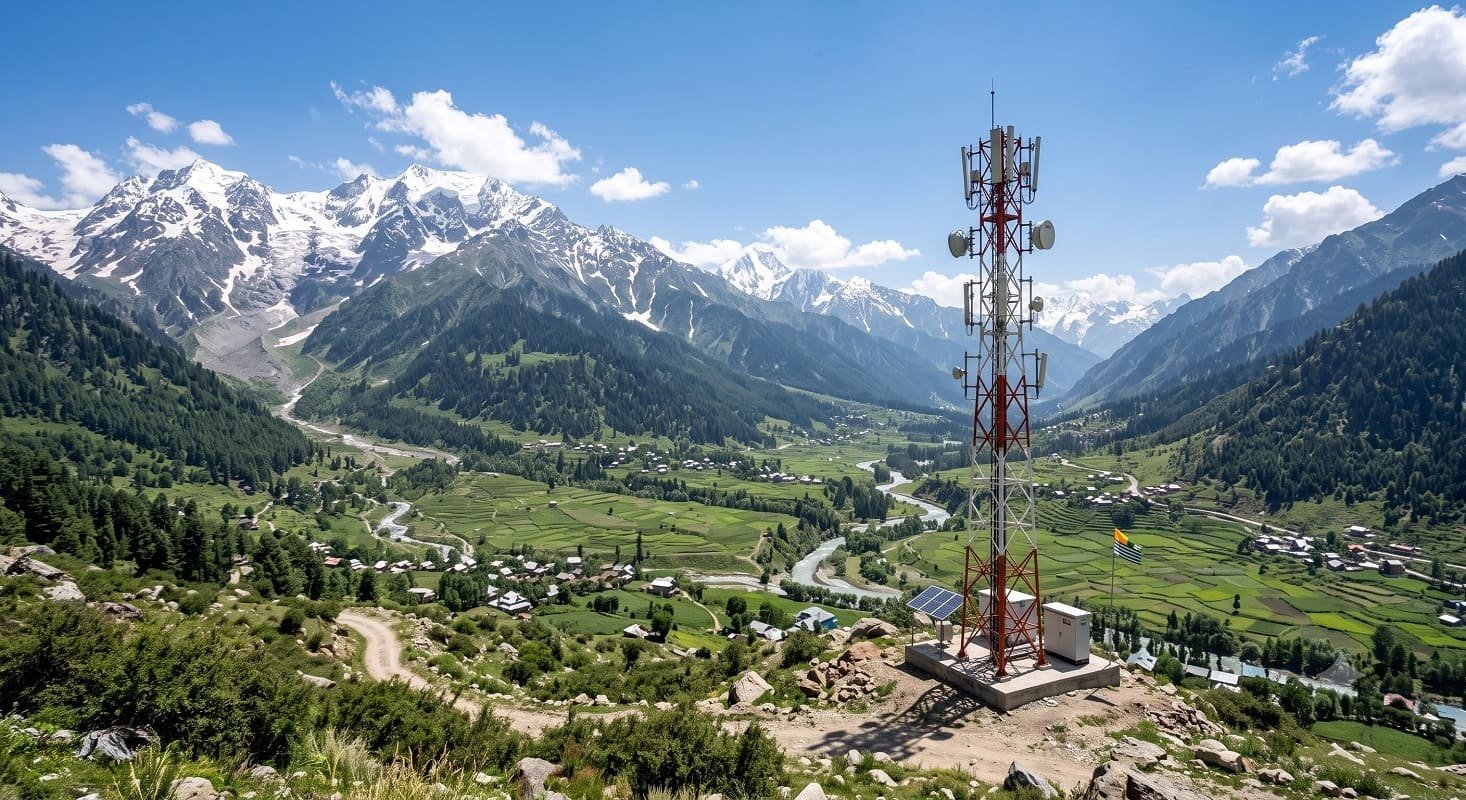
DoT has reportedly raised the permissible EMF power density for 5G base stations, potentially supporting wider coverage and more efficient network deployment.
India 5G radiation limits have reportedly been revised by the Department of Telecommunications (DoT), with the permissible electromagnetic field (EMF) power density for 5G mobile base stations increased from 5 W/m² to 10 W/m². The move brings India’s permissible limit closer to the international benchmark established by the International Commission on Non-Ionizing Radiation Protection (ICNIRP).
The change could have an important impact on India’s 5G network expansion. Higher permissible emission levels could allow operators to optimise coverage from existing base stations and potentially reduce the number of additional sites required in certain deployment scenarios.
The development is particularly relevant for operators such as Vodafone Idea, which is continuing to expand its 5G network while managing significant capital expenditure requirements.
India 5G Radiation Limits Rise From 5 W/m² to 10 W/m²
The revised India 5G radiation limits increase the permissible power density ceiling for 5G mobile base stations from 5 W/m² to 10 W/m². Power density is a measure used to describe the amount of electromagnetic energy passing through a given area.
For telecom networks, EMF limits determine the maximum permitted exposure levels around wireless transmission equipment. These limits are established to ensure that radio-frequency emissions from telecom infrastructure remain within prescribed safety thresholds.
The increase does not mean that every mobile tower will automatically transmit at the new maximum level. Actual transmission power depends on network configuration, spectrum holdings, equipment capabilities, traffic requirements and regulatory conditions.
Instead, the revised India 5G radiation limits provide operators with greater permissible headroom when planning and operating compatible 5G infrastructure.
DoT Aligns India With ICNIRP Benchmarks
A major aspect of the India 5G radiation limits revision is the reported alignment with ICNIRP recommendations.
ICNIRP develops international guidelines for limiting exposure to non-ionising radiation, including radio-frequency electromagnetic fields used by wireless communication systems. Its recommendations are used as reference points by regulators and countries around the world.
By moving from 5 W/m² to 10 W/m², India’s permissible limit is being aligned more closely with the benchmark cited for international telecom deployments.
This does not mean that India is abandoning EMF safety regulations. The revised limit remains part of the regulatory framework governing radio-frequency emissions from telecom infrastructure.
What Higher 5G EMF Limits Could Mean for Network Coverage
The practical significance of the India 5G radiation limits could become clearer as operators expand their networks into areas where coverage and site availability remain challenging.
A mobile base station has a finite coverage area, and the effective range of a 5G signal depends on several factors. These include the frequency band being used, antenna configuration, transmission power, terrain, buildings, network density and interference from other cells.
Where regulatory limits are one of the constraints on transmission power, additional permissible headroom could allow operators to optimise coverage more effectively.
However, the revised India 5G radiation limits should not be interpreted as meaning that a single tower will automatically replace several existing towers. 5G network capacity depends heavily on site density, spectrum availability and user traffic, meaning operators still require sufficient infrastructure in high-demand areas.
Could India 5G Radiation Limits Reduce Network Capex?
One of the potential benefits for telecom operators is improved capital efficiency.
Building a mobile network requires substantial investment in towers, antennas, radios, transmission equipment, power systems and backhaul infrastructure. Every additional site can therefore increase both deployment and ongoing operating costs.
If higher permissible emission levels allow an operator to achieve the required coverage with fewer additional sites in specific locations, network rollout costs could potentially decline.
The impact would vary considerably between urban, suburban and rural deployments. Dense urban areas require a large number of sites because network capacity is often the primary constraint, while rural regions can be more heavily influenced by coverage and distance between locations.
The revised India 5G radiation limits could therefore be particularly useful in areas where operators need to extend 5G coverage over larger geographic regions.
Vodafone Idea Could Benefit From the Change
The change could be relevant to Vodafone Idea’s ongoing 5G expansion.
Vodafone Idea has been gradually increasing its 5G footprint after beginning commercial 5G deployment in selected Indian markets. The operator faces the additional challenge of expanding coverage while maintaining financial discipline and controlling capital expenditure.
Any regulatory change that allows existing infrastructure to be used more efficiently could therefore be beneficial.
The revised India 5G radiation limits could provide Vodafone Idea and other operators with another network-planning tool. Instead of relying exclusively on new sites, operators may be able to optimise existing infrastructure where spectrum, equipment and local deployment conditions permit.
That could be particularly useful for extending 5G into locations where building new sites is expensive or time-consuming.
Higher Emission Limits Do Not Automatically Mean Faster 5G
It is important to distinguish between permitted transmission power and actual network performance.
A higher regulatory ceiling does not automatically translate into faster download speeds for consumers. 5G performance depends on spectrum bandwidth, carrier aggregation, network congestion, backhaul capacity, device capabilities and the technology deployed by the operator.
For example, a tower operating on a relatively narrow spectrum allocation may not deliver dramatically higher speeds simply because the permitted EMF limit has increased.
The primary potential advantage of the revised India 5G radiation limits is greater flexibility in network deployment and coverage planning rather than an automatic speed increase.
What Are EMF Limits for Mobile Towers?
EMF limits are regulatory thresholds governing exposure to electromagnetic fields generated by wireless equipment.
Mobile networks use radio-frequency signals to connect smartphones and other wireless devices to base stations. Since these signals involve non-ionising electromagnetic radiation, regulators establish exposure limits based on scientific assessments and safety guidelines.
Telecom operators are required to ensure that their infrastructure operates within the applicable limits.
The India 5G radiation limits therefore form part of the broader regulatory framework governing mobile network infrastructure. Compliance is not limited to 5G alone and involves requirements applicable to telecom transmission equipment.
Why the Revision Matters for India’s 5G Expansion
India has one of the world’s fastest-growing 5G markets, with operators continuing to expand coverage and subscriber adoption.
As deployment moves beyond major cities, network economics become increasingly important. Operators need to balance coverage requirements with the cost of acquiring sites, installing equipment, providing power and maintaining backhaul connectivity.
The revised India 5G radiation limits could help address one part of this equation by giving operators additional flexibility in how radio infrastructure is configured.
This could be particularly relevant for rural and semi-urban markets where the distance between sites is greater and the economics of deploying large numbers of towers can be challenging.
The Change Is More About Efficiency Than Just Power
The significance of the India 5G radiation limits should therefore be viewed from a network-efficiency perspective.
Telecom operators will still need to maintain regulatory compliance, manage interference and design networks around the characteristics of individual spectrum bands. Increasing the permissible power density does not eliminate these technical limitations.
However, additional regulatory headroom could allow operators to make more efficient use of existing infrastructure.
For India’s telecom industry, where operators are simultaneously expanding 5G coverage and managing large investment requirements, even incremental improvements in network efficiency can have commercial significance.
India 5G Radiation Limits Could Support Wider Rollout
The reported increase in India 5G radiation limits from 5 W/m² to 10 W/m² represents a notable change in the regulatory environment for mobile networks.
The alignment with ICNIRP benchmarks could give operators additional flexibility while planning 5G deployments. It could also potentially reduce the number of new sites required in certain coverage-focused scenarios, although the actual impact will depend on individual network conditions.
For Vodafone Idea, the change could be particularly useful as the operator continues its 5G rollout while attempting to manage capital expenditure.
For consumers, the most visible impact may eventually come through broader 5G availability rather than a direct increase in smartphone speeds.
The next phase will depend on how telecom operators incorporate the revised India 5G radiation limits into their network planning and whether the change translates into measurable improvements in coverage, deployment efficiency and rollout economics.
