

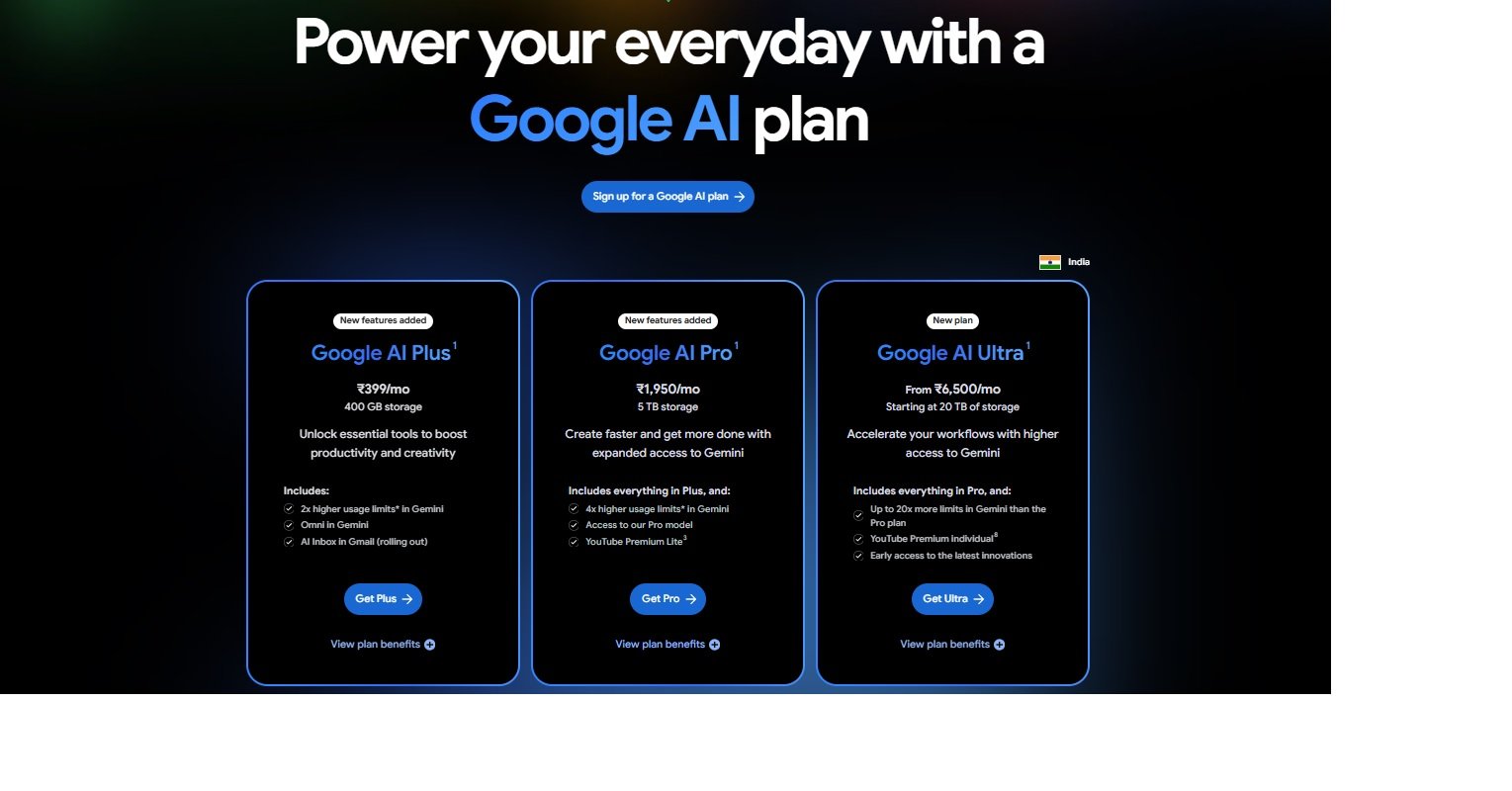
In a massive structural shift to its cloud storage and consumer subscription ecosystem, California-based technology giant Google has announced a major upgrade to its Google One platform. Moving away from standard data storage tiers, the company is aggressively pivoting toward an AI-first paradigm. As part of this transition, Google has officially rebranded its high-end tiers under a new “Google AI” suite, introducing a dedicated AI Credit System for all users.
The new architecture applies universally to both fresh sign-ups and existing members. Current Google One subscribers are slated to receive system emails mapping out exactly how their current storage tiers will transition to the new credit framework.
Why Google is Shifting to an AI Credit System
For years, cloud subscriptions like Google One were priced purely on storage metrics: gigabytes or terabytes used across Gmail, Google Drive, and Google Photos. However, the heavy computational demands of running next-generation generative AI tools require immense backend processing power.
By introducing an AI Credit System, Google is bringing a transparent, usage-based approach to consumer AI. Under this layout, advanced workflows—such as rendering cinema-grade video or executing autonomous software engineering tasks—consume a set allotment of tokens. If a power user runs out of their baseline monthly limits, they are no longer forced into an expensive plan upgrade. Instead, they can buy additional credit packs directly through Google One to sustain their operational momentum.
Deep Dive: The New Google AI Subscription Matrix
The updated Google One infrastructure consolidates its high-end offerings into three distinct plans: Google AI Plus, Google AI Pro, and Google AI Ultra. Each tier represents a unique level of storage and computing power tailored to standard consumers, creative professionals, and software developers.
The Google AI Plus Tier
Priced at ₹399 per month, this serves as the entry point into Google’s advanced cognitive network, designed primarily for students, writers, and casual creators. Subscribers receive a 400 GB pool of cloud storage shared across Gmail, Drive, and Photos.
In terms of intelligence, the tier grants enriched access to the Gemini 3.1 Pro model and limited exposure to Gemini Omni Flash. It also features Deep Research, an automated research assistant that parses hundreds of live web elements to construct detailed, cited research summaries in minutes. Full family sharing support is included, allowing the storage pool and baseline AI access to be extended to up to five other individuals.
The Google AI Pro Tier
Positioned at ₹1,950 per month, this is the premier option geared toward power users, heavy content creators, and independent developers. It includes a much roomier 5 TB cloud storage allotment to smoothly handle high-resolution media.
For creators, it unlocks access to the Google Flow ecosystem, providing 1,000 dedicated Flow credits per month to generate cinematic scenes, music tracks, and high-fidelity video edits via conversational prompts. Developers get expanded rate limits for Google Antigravity, an agentic development workspace where engineers can delegate structural coding tasks to autonomous software agents. It also includes seamless integration with Jules inside Android Studio, facilitating higher task and concurrency limits for mobile app generation. As an added lifestyle perk, the tier bundles a YouTube Premium Lite individual plan, removing ads on the majority of video content.
The Google AI Ultra Tier
Starting at ₹6,500+ per month, this represents the absolute peak of consumer cloud computing, offering elite processing bounds and total digital automation. It includes enterprise-grade storage starting at 20 TB, which can scale up to 30 TB depending on individual configurations.
The primary highlight is the Deep Think Reasoning mode, which unlocks a specialized reasoning layer within Gemini designed to work through highly complex statistical, mathematical, or logic-driven coding requests. The tier injects full AI integration directly into enterprise apps like Google Docs, Sheets, and Gmail, allowing for high-capacity document processing of up to 1,500 pages. Creative and technical limits are pushed to the max, offering up to 25,000 monthly Google Flow credits and maximum agent velocity in Antigravity. Finally, it absorbs a full, unrestricted YouTube Premium individual plan for ad-free video, offline playback, and background streaming.
Centralized Activity Dashboards & Family Pooling
To help users track their resource consumption, Google has launched a unified AI Activity Dashboard. Accessible via the web or mobile applications, this hub displays exactly how many credits have been consumed across different integrated applications like Flow and Antigravity.
Crucially, to keep billing transparent and secure, only the designated primary plan manager has administrative permissions to buy additional credit packs, initiate a tier upgrade, or execute a plan downgrade. The dashboard neatly breaks down household usage from highest to lowest consumer, giving families complete fiscal control over their digital footprint.
Understanding Google Flow and Google Antigravity
The two main drivers behind the newly established credit marketplace are Google Flow and Google Antigravity—two highly advanced platforms designed to automate complex human workloads.
Google Flow: AI Filmmaking Made Fluid
Google Flow converts video editing from a technical hurdle into a conversational exercise. Utilizing underlying generative video frameworks like Veo 3, users can input raw text prompts or upload existing footage to construct complex cinematic cuts. Flow allows for rapid visual reimagining, frame upscaling, and dynamic musical synthesis, turning raw creative ideas into production-ready content pieces without lengthy rendering barriers.
Google Antigravity: The Rise of Autonomous Code Agents
Rather than acting as a standard autocomplete extension, Google Antigravity is an autonomous development engine. Developers can feed Antigravity broad software goals. The agent then reads through existing local files, drafts clean code blocks, creates testing protocols in browser sandboxes, and handles terminal debugging workflows on its own. It represents a massive leap forward for engineering productivity, freeing developers to focus on overall application architecture rather than repetitive debugging cycles.
For the latest tech news, follow TelecomByte on X, Facebook and Google News.
