BSNL’s FTTH base has crossed 4.5 million active connections, highlighting the state-run operator’s growing focus on expanding broadband access across India.
BSNL FTTH has crossed more than 4.5 million active broadband connections in India, highlighting the state-run telecom operator’s continued push to expand high-speed fixed broadband services. The growth comes as BSNL works with local partners and leverages BharatNet infrastructure to extend fibre connectivity beyond major cities and into smaller towns and villages.
BSNL FTTH has become an important part of the operator’s broadband strategy as competition in India’s fixed broadband market continues to intensify. Private operators such as Jio and Airtel have expanded their fibre networks aggressively, while BSNL is attempting to use its extensive network footprint and local-level partnerships to strengthen its position.
BSNL FTTH Expansion Gains Momentum
BSNL FTTH now serves more than 4.5 million active broadband connections, making fibre broadband an increasingly important component of the company’s consumer business. Unlike older copper-based broadband connections, fibre-to-the-home technology can support substantially higher speeds and more reliable data transmission.
The expansion of BSNL FTTH is particularly significant in areas where private broadband providers may have a smaller physical presence. BSNL’s existing telecom infrastructure and access to government-backed connectivity programmes can help it reach locations that are commercially less attractive for large private operators.
For customers, the availability of fibre broadband can also improve the quality of services such as video streaming, online education, cloud applications, gaming and work-from-home connectivity.
BharatNet Helps BSNL Reach Rural Markets
One of the major factors supporting BSNL FTTH expansion is the broader deployment of fibre infrastructure through BharatNet.
BharatNet is designed to extend broadband connectivity to rural and remote parts of India by creating a nationwide optical-fibre network. BSNL and its partners can use this infrastructure to support last-mile broadband services in locations where conventional private-sector fibre deployment may take longer.
The village-level approach is important because India’s broadband growth is increasingly moving beyond large urban centres. Once fibre infrastructure reaches a village or smaller town, local service providers can potentially connect individual homes and businesses through FTTH connections.
This creates an opportunity for BSNL FTTH to compete in markets where the operator has historically had a strong presence through its telecom infrastructure.
BSNL FTTH Competes With Jio and Airtel
BSNL FTTH operates in an increasingly competitive broadband market. Reliance Jio and Bharti Airtel have both invested heavily in expanding their fibre broadband networks, particularly in urban and semi-urban locations.
Private operators generally compete through a combination of higher speeds, bundled entertainment services, OTT subscriptions and integrated broadband-mobile offerings. BSNL, meanwhile, has been relying on its broad network reach, pricing options and partnerships to remain competitive.
The competition is particularly important for consumers because broadband providers are no longer selling connectivity alone. Subscribers increasingly expect high-speed internet along with entertainment, smart-home capabilities and access to digital services.
Why Fibre Broadband Is Important
The growth of BSNL FTTH reflects the wider transition from traditional fixed-line broadband towards fibre-based connectivity.
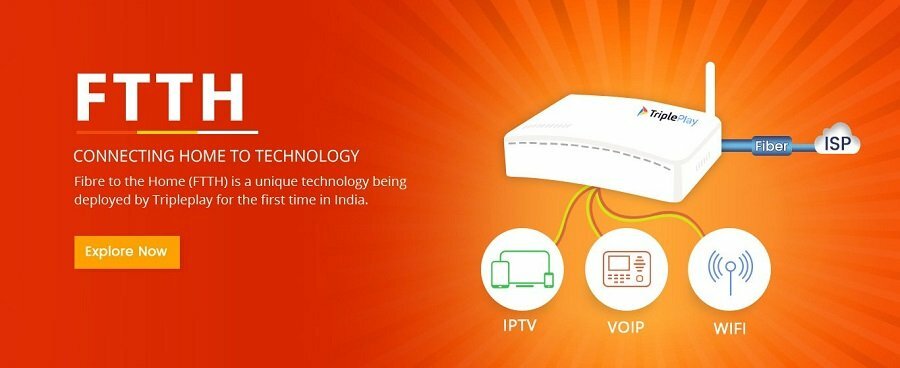
FTTH uses optical fibre directly to the customer’s premises. Fibre can carry large volumes of data with low signal loss, making it suitable for high-speed broadband services and increasing data consumption.
This is becoming more relevant as households connect multiple devices simultaneously. A typical connected home may have smartphones, smart televisions, laptops, tablets, security cameras and other internet-connected devices operating at the same time.
Higher-capacity fibre networks can therefore provide a stronger foundation for these usage patterns compared with older broadband technologies.
BSNL FTTH Could Benefit From Rural Demand
Rural broadband represents one of the biggest potential growth areas for BSNL FTTH.
India’s digital services ecosystem has expanded considerably beyond metropolitan areas, with consumers increasingly relying on internet connectivity for education, government services, digital payments, entertainment and online commerce.
However, the availability of reliable fixed broadband remains uneven across different regions. Mobile networks provide connectivity to a large portion of the population, but fixed broadband can offer a more consistent high-capacity connection for households with heavy data consumption.
BSNL’s ability to use existing infrastructure and work with local partners could therefore help it address this demand.
Local Partnerships Become Important
The expansion of BSNL FTTH is not dependent entirely on BSNL deploying every last-mile connection itself. Local partners can play an important role in connecting individual homes and businesses.
This approach allows the operator to use a distributed model in which local internet service providers and franchise partners handle customer acquisition, installation and last-mile operations in different markets.
Such partnerships can be particularly useful in villages and smaller towns, where local operators understand customer requirements and local infrastructure better than a centralised organisation.
For BSNL, this model can potentially accelerate broadband expansion while reducing the need to directly manage every last-mile connection.
BSNL FTTH Faces Private ISP Competition
Although the 4.5 million-plus connection milestone is significant, BSNL still faces strong competition from private broadband providers.
Reliance Jio has built a large fixed broadband business alongside its mobile network, while Airtel has expanded its Xstream Fiber footprint across numerous Indian markets. Regional internet service providers also remain important in several cities and towns.
The challenge for BSNL FTTH will therefore be to maintain subscriber growth while improving service quality, installation speed and customer support.
Broadband customers are generally sensitive to network reliability. Attractive pricing can help acquire subscribers, but consistent speeds and quick resolution of service problems are equally important for retaining them.
What the BSNL FTTH Growth Means for India
The expansion of BSNL FTTH could have broader implications for India’s digital connectivity ambitions.
A stronger fixed broadband network can complement India’s mobile connectivity infrastructure and provide households with an alternative to relying entirely on mobile data.
It can also support the increasing adoption of smart televisions, cloud services, online learning and other high-bandwidth applications.
For rural India, the impact could be particularly meaningful if fibre connectivity reaches more villages and becomes available at competitive prices.
The Road Ahead for BSNL Broadband
BSNL FTTH’s expansion beyond 4.5 million active connections demonstrates that fibre broadband remains an important growth opportunity for the state-run operator. BharatNet infrastructure and partnerships with local broadband providers could help BSNL extend its reach further into underserved markets.
However, subscriber numbers alone will not determine the long-term success of BSNL’s broadband strategy. The operator will also need to focus on network uptime, installation timelines, customer service and competitive broadband packages.
As India’s fixed broadband market becomes increasingly competitive, BSNL’s ability to convert its extensive infrastructure advantage into dependable last-mile services will be crucial. The continued growth of BSNL FTTH could ultimately strengthen broadband availability in both urban and rural markets, provided the operator can maintain service quality while expanding its footprint.