

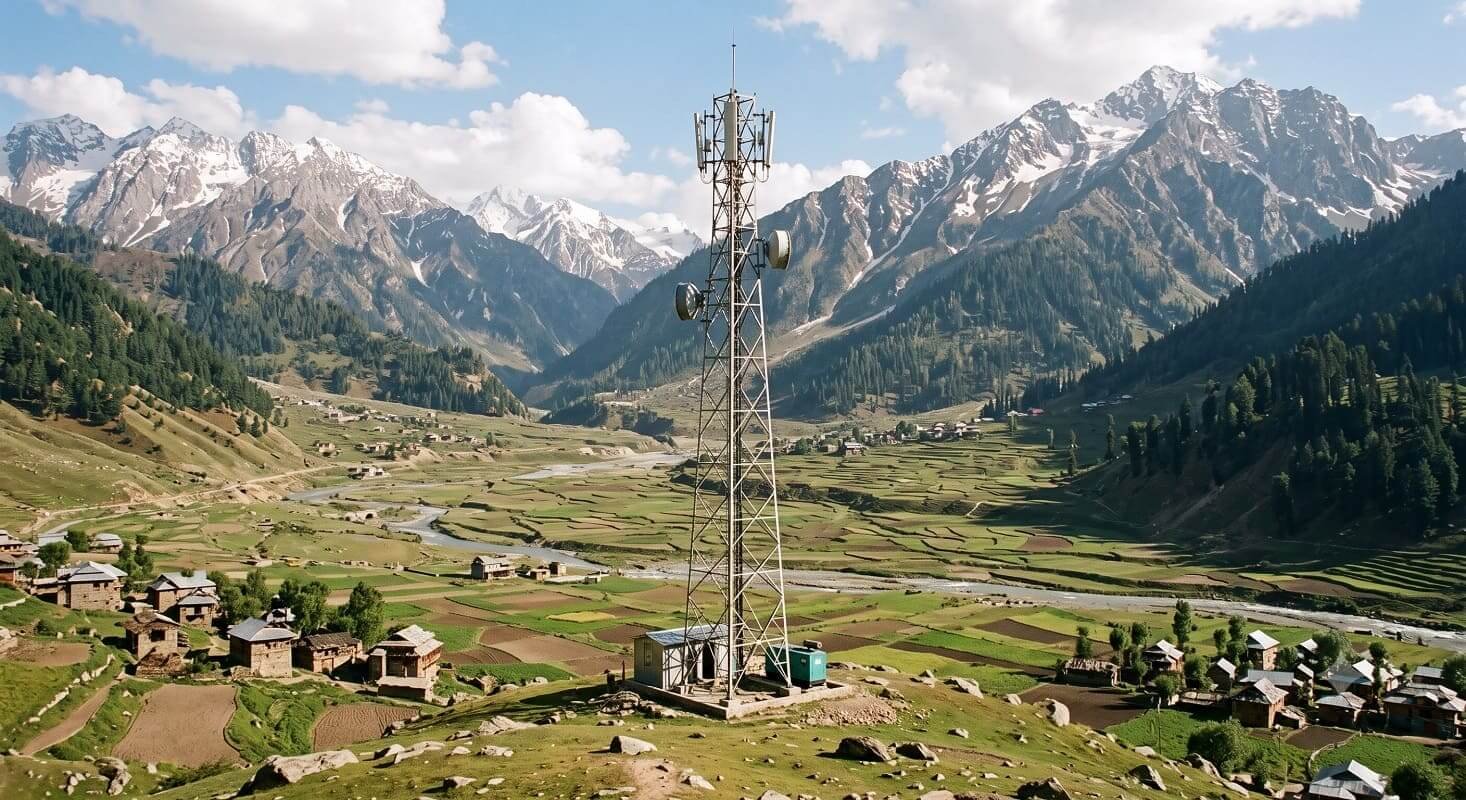
India has crossed 550 million 5G users, marking another major milestone in the country’s rapid transition to next-generation mobile connectivity. Communications Minister Jyotiraditya Scindia has now set a much larger target: India aims to connect 1 billion 5G users by 2030 as the country simultaneously prepares for the transition towards 6G.
The announcement was made at the inauguration of India Mobile Congress 2026 at Yashobhoomi in New Delhi on October 8. According to the Ministry of Communications, India’s 5G rollout has reached 550 million users across 99.9% of the country’s districts.
From 400 Million to 550 Million 5G Users
The latest figure shows how quickly India’s 5G adoption has accelerated.
In February 2026, Scindia had told the Lok Sabha that around 400 million citizens were benefiting from 5G services and that the government was targeting 1 billion users by 2030. At the time, the government also said 5G had reached 99.9% of districts, with more than 5 lakh 5G base stations deployed.
The new 550 million figure represents an increase of 150 million over that earlier reported level. It also means the government has moved from talking primarily about rapid network rollout to measuring the scale of actual 5G adoption.
The government now says 5G has reached 550 million users across 99.9% of districts, while India has around 5.5 lakh 5G base stations. Prime Minister Narendra Modi, speaking at IMC 2026, also highlighted the 5G base-station figure and said mobile internet speeds had increased tenfold since 2022.
India Wants 1 Billion 5G Users by 2030
The next target is significantly more ambitious.
Scindia said India wants to increase the 5G user base from 550 million today to 1 billion by 2030. That would require adding another 450 million 5G users over the next four years.
In simple terms, India would need to expand the 5G user base by roughly 82% from the current level. If growth were evenly distributed, reaching 1 billion would require an annualised growth rate of about 16% from the 550-million starting point.
That does not mean adoption will necessarily follow a straight line. Growth could accelerate as 5G smartphones become cheaper, more consumers replace older devices and operators expand capacity, while it could also slow as the addressable user base becomes increasingly saturated.
The target therefore represents not just a network-building challenge but an adoption challenge.
99.9% District Coverage Changes the 5G Question
One of the most important aspects of India’s current 5G story is the difference between network availability and actual usage.
The government says 5G is available in 99.9% of districts. That is a measure of geographic reach, while the 550 million figure reflects users benefiting from 5G services as described by the government.
This distinction matters because the next stage of India’s 5G journey will increasingly depend on how many people actually use 5G-capable devices and services, rather than simply whether a 5G signal is available in their district.
The ecosystem therefore has to move together. Operators need to continue investing in capacity, smartphone manufacturers need to offer affordable 5G devices, and consumers need compelling reasons to use 5G rather than treating it simply as a faster version of existing mobile connectivity.
What Will Drive the Next 450 Million Users?
Affordable 5G smartphones will be one of the biggest factors.
India has already built a large installed base of 5G devices, but reaching another 450 million users will require continued replacement of older 4G handsets. The lower end of the smartphone market will therefore remain important for 5G adoption.
Network economics will matter as well. Operators have invested heavily in spectrum and infrastructure, and the focus will increasingly shift towards increasing network utilisation and monetising the capacity already deployed.
The government’s latest IMC announcement also highlighted the broader growth of India’s telecom ecosystem. It said India now has more than 1.35 billion telecom subscribers and over 1.09 billion broadband connections. Average monthly data consumption has risen from 0.26GB a decade ago to more than 36GB, while data costs have fallen sharply.
That combination of falling access costs and rising consumption has been one of the biggest drivers of India’s digital transformation.
5G Is Also Becoming More Than a Smartphone Technology
The 1-billion target should not be viewed only through the lens of smartphone users.
The government’s broader 5G strategy increasingly includes enterprise networks, industrial applications, fixed wireless access, connected devices, smart infrastructure and other use cases.
At IMC 2026, the government highlighted demonstrations spanning satellite connectivity, cell broadcast, AI-native pre-6G networks, sovereign cloud, terahertz communications and integrated sensing and communication.
This points towards a broader role for telecom networks in India’s digital economy.
For consumers, the visible benefit may remain faster mobile connectivity and better network capacity. For businesses, however, the more important opportunity could be private networks, automation, connected machines, low-latency applications and network-enabled services.
India’s 5G Success Is Becoming the Foundation for 6G
The 5G milestone is arriving at the same time that India is increasing its focus on 6G.
Scindia said at IMC 2026 that the Bharat 6G Alliance, which includes 90 institutions, has established 7,700 patents, including 4,400 international patents. He also reiterated India’s ambition to become a global leader in 6G.
The figures are significant, but they should be understood carefully. The government’s wording refers to patents established by the Bharat 6G Alliance; the number should not automatically be interpreted as 7,700 granted Standard Essential Patents. The commercial importance of these patents will ultimately depend on their technology, standards relevance, ownership and adoption.
That distinction will become increasingly important as India tries to move from being a major telecom market to becoming a developer and exporter of telecom technology.
The Bigger Shift: From Telecom Consumer to Technology Creator
The 550-million 5G milestone is therefore part of a much larger story.
India’s telecom journey has moved from basic voice connectivity to mobile broadband, then to a nationwide 4G data economy and now to large-scale 5G deployment.
The next phase is about what India can build on top of that connectivity.
The government wants India to participate more actively in telecom standards, develop intellectual property, manufacture network equipment and create technologies that can be exported to other markets. Prime Minister Narendra Modi said at IMC 2026 that India has moved from being a consumer towards becoming a creator, with the ambition for product design, technology and intellectual property to increasingly originate in India.
That is where the 5G-to-6G transition becomes particularly important.
Can India Reach 1 Billion 5G Users by 2030?
The target is ambitious, but the starting position is substantially different from India’s earlier mobile generations.
5G has already reached almost every district, the country has a large and expanding 5G device ecosystem, and operators have deployed hundreds of thousands of 5G base stations. The latest government figure of 550 million users means India has already built a very large 5G adoption base.
The harder question is what happens from here.
The next 450 million users will increasingly come from consumers upgrading older smartphones, users in smaller towns and rural areas, and customers who need a stronger reason to choose 5G beyond simply seeing a 5G icon on their phone.
At the same time, operators will need to balance network investment with returns, while handset makers and the wider technology ecosystem will have to keep 5G devices accessible to a price-sensitive Indian market.
What the 1 Billion Target Means for Indian Consumers
For consumers, the most important outcome may not be the number itself.
A larger 5G user base should support greater network utilisation and encourage development of services designed around higher speeds, lower latency and greater capacity. It could also strengthen the case for 5G-based home broadband, connected devices, cloud gaming, immersive applications and enterprise services.
But 1 billion users will not automatically mean that every consumer receives the same quality of service.
Network performance will continue to vary by location, spectrum holdings, congestion, backhaul, device capability and operator investment. The next phase of India’s 5G story will therefore be about network quality and useful services as much as raw subscriber numbers.
India has already demonstrated that it can deploy telecom infrastructure at extraordinary scale. The next challenge is to turn that scale into sustained technology innovation, stronger digital businesses and meaningful benefits for consumers.
The jump from 550 million to 1 billion 5G users will be one of the clearest measures of whether India can carry the momentum of its 5G rollout into the second half of the decade, while simultaneously building the technology ecosystem needed for 6G.
