

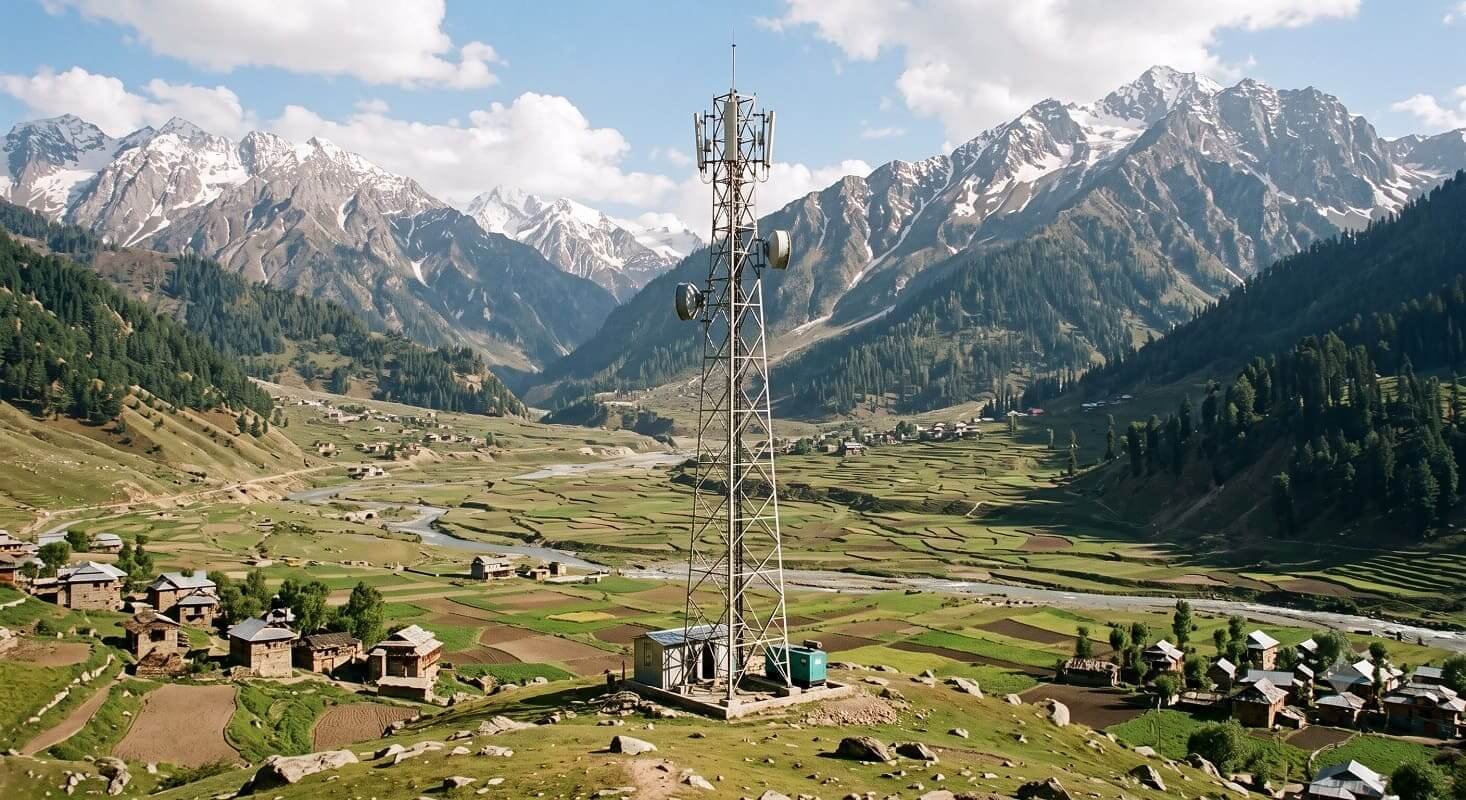
The number of villages in India without 4G mobile connectivity has declined by nearly 75% in four years, falling from 45,180 in 2022 to 11,372 in 2026, according to the Department of Telecommunications (DoT).
In a statement issued on November 11, the government highlighted the progress made through its 4G Saturation Project, alongside network expansion by private telecom operators. State-run Bharat Sanchar Nigam Limited (BSNL) has commissioned 18,291 mobile sites under the project, helping extend 4G services to previously unconnected rural and remote areas.
The government has also sanctioned another 26,000 mobile network sites to address the remaining coverage gaps. However, difficult terrain, scattered settlements and the high cost of infrastructure continue to make connectivity expansion challenging in some parts of the country.
India reduces 4G-uncovered villages from 45,180 to 11,372
According to the DoT, the number of villages without 4G connectivity declined from 45,180 in 2022 to 11,372 in 2026. This represents a reduction of approximately 74.8%.
The government’s 4G Saturation Project was designed to provide connectivity to 24,680 previously unconnected villages. BSNL is implementing the rollout, while private telecom service providers have also contributed to rural coverage through their own network expansion.
The latest figures indicate substantial progress, but the remaining 11,372 villages show that universal 4G coverage has not yet been achieved.
Remote tribal settlements, geographically difficult locations and areas with dispersed populations remain among the more challenging locations for mobile network deployment.
BSNL’s 18,291 4G sites record 1.86 crore GB data usage
BSNL has commissioned 18,291 sites under the 4G Saturation Project’s 24,680-site rollout plan.
The DoT said these sites recorded total data consumption of 18,659,170 GB, or approximately 1.87 crore GB, during October 2026.
The sites served a maximum of 10,21,048 active users on a single day during the month. The government also reported average monthly data consumption of 18.3 GB per user and approximately 56 active users per site.
These figures provide an indication of how the newly deployed infrastructure is being used. Rather than simply counting commissioned towers, the reported traffic and active-user numbers offer a measure of actual network activity in the areas covered by the project.
The rollout is particularly relevant for rural communities that previously had limited or no access to 4G mobile services. Connectivity can support digital payments, online education, telemedicine, government services and access to internet-based communication.
Government sanctions another 26,000 mobile network sites
The government has sanctioned an additional 26,000 mobile network sites for the next phase of rural connectivity expansion.
The new sites are expected to help address the remaining coverage gaps, particularly in remote and underserved locations. The DoT has identified difficult terrain, high infrastructure costs, scattered settlements and remote tribal habitations as key challenges.
The additional sites are separate from the 18,291 BSNL sites already commissioned under the 4G Saturation Project.
The government has also highlighted network-sharing arrangements and better utilisation of existing telecom infrastructure as important measures for expanding connectivity. This approach can help operators improve coverage without relying exclusively on building new sites in every location.
Private telecom operators also contribute to rural 4G expansion
Although BSNL is the primary implementing operator for the government’s 4G Saturation Project, the DoT has recognised the role of private telecom service providers in reducing the number of villages without 4G connectivity.
Bharti Airtel, Reliance Jio and Vodafone Idea have continued to expand their mobile networks, including in rural markets. Their investments in towers, spectrum, transmission and 4G coverage have contributed to the wider expansion of mobile broadband access.
The government’s latest announcement does not provide an operator-wise breakdown of how many villages were connected by BSNL, Airtel, Jio or Vi. Therefore, the nearly 75% reduction should be viewed as an overall national coverage improvement rather than a result attributable entirely to BSNL.
BSNL and Vodafone Idea explore wider network sharing
Another development that could support coverage expansion is the proposed expansion of network-sharing arrangements between BSNL and Vodafone Idea (Vi).
The two operators already have intra-circle roaming arrangements in Delhi and Mumbai, under which BSNL subscribers can access Vi’s network on a revenue-sharing basis.
A Department of Telecommunications report submitted to Parliament in August 2026 also said BSNL had leased approximately 1,441 towers to Vi as of April 2026. The report described existing infrastructure-sharing arrangements and progress on fibre sharing, including a proof of concept involving BharatNet infrastructure.
Separately, reports published in November said BSNL planned to extend roaming arrangements with Vi to additional telecom circles. A government source cited by PTI said the operators had arrangements in two to three circles and were planning to add another 12 to 13 circles.
However, the proposed expansion should not be confused with a completed nationwide network-sharing agreement. The precise rollout locations, commercial terms and customer eligibility have not been fully detailed publicly.
Intra-circle roaming allows a subscriber to access a partner operator’s network within the same telecom service area where the subscriber’s own network has limited coverage. Wider arrangements could help both operators use existing network capacity more efficiently and improve connectivity in selected locations.
What remains before India achieves wider 4G coverage?
The reduction in uncovered villages is an important step towards improving rural digital access, but the remaining gap will require continued investment and coordination between the government and telecom operators.
The next phase will depend on the timely deployment of the additional 26,000 sites, reliable power and backhaul connectivity, and the ability to maintain network services in remote locations.
Network sharing between operators could also help reduce duplication and accelerate coverage expansion. At the same time, the government will need to ensure that commissioned sites deliver reliable services and are not counted as successful coverage additions merely because infrastructure has been installed.
For BSNL, the 4G Saturation Project is also important as it expands the operator’s mobile broadband footprint and creates a foundation for future network upgrades.
India’s progress in reducing villages without 4G connectivity is significant, but the next challenge is to connect the remaining underserved areas and ensure that rural users receive consistent mobile broadband services.
